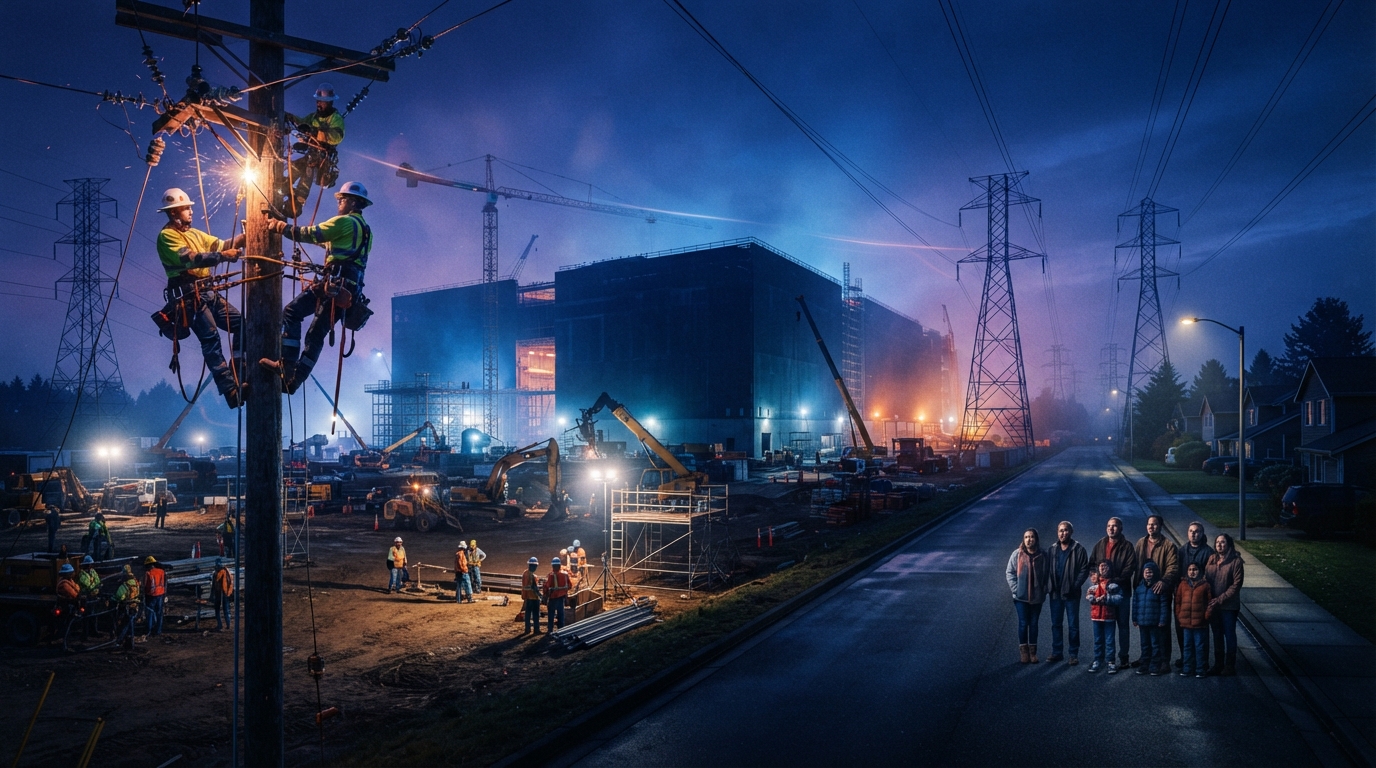
OpenAI, Blackstone, SoftBank, and data-center operator QTS have joined six building-trade unions -- including the International Brotherhood of Electrical Workers -- in a new coalition aimed at stopping state and local governments from freezing new AI data-center construction. The group, called the American Infrastructure Alliance, is running what a spokesperson described as a "high eight-figure campaign" in seven target states: Texas, Georgia, Ohio, Iowa, Pennsylvania, Indiana, and South Carolina. Its pitch is standards, not exemptions -- rules on who pays for the power and infrastructure a new data center requires, aimed at heading off blanket construction bans before more of them pass.
The Alliance exists because the opposition it's responding to is no longer fringe. A September survey from the Annenberg Public Policy Center found 61% of US adults now oppose data-center construction in their own area -- up 12 percentage points in four months, and crossing party lines. More than 300 data-center-related bills were introduced nationwide in just the first six weeks of 2026, and moratorium bills have reached 11 state legislatures this year even as dozens of municipalities have moved faster, passing local construction pauses of their own.
How the fight escalated to a seven-state campaign
- May 7, 2026 — The Lysander, NY town board approves a six-month moratorium after more than 350 residents turn out to oppose a proposed data center.
- May 23, 2026 — Demonstrators protest at the Utah State Capitol over the 9-gigawatt Stratos data center in Box Elder County.
- Aug 2026 — Texas Gov. Greg Abbott directs regulators to audit every data center seeking a grid connection and pause new approvals pending the review.
- Sep 2026 — Pennsylvania Gov. Josh Shapiro signs an executive order tightening data-center development rules.
- Sep 28, 2026 — OpenAI, Blackstone, SoftBank, QTS, and six construction unions launch the American Infrastructure Alliance.
- 2027 legislative sessions — The Alliance's stated target for introducing its own data-center standards in the seven named states.
None of the Alliance's seven target states has already lost this fight the way New York and Maine have, in different ways. New York's legislature passed the Responsible Data Center Development Act in June -- a one-year moratorium on permits for facilities drawing 20 megawatts or more -- but Gov. Kathy Hochul never signed it. Instead, she bypassed the bill entirely and issued her own Executive Order No. 62 in July, setting a 50-megawatt threshold and an indefinite pause that lasts until state regulators finish a full environmental review, not a fixed year. Maine's legislature passed a similar 18-month moratorium with bipartisan support that April, only for Gov. Janet Mills to veto it -- not over the general principle, which her own veto letter endorsed, but to protect one $550 million project in the town of Jay; the House fell seven votes short of the two-thirds needed to override her. At least 11 states had moratorium-style bills pending as of early this year. The seven states the Alliance picked are, by that count, states where the legislative outcome is still genuinely open -- a preemptive campaign everywhere a vote hasn't happened yet, not a defensive one in a state that already set a rule.
IBEW president Kenneth Cooper framed the stakes for his own members bluntly: "Blanket bans on necessary infrastructure projects would set back our economy and threaten good middle-class jobs." Blackstone's Tag Greason put the companies' side of it in softer language -- "Responsible growth requires clear expectations for everyone involved" -- which is also, read plainly, an argument for rules that let construction continue rather than rules that stop it. Both framings describe the same underlying trade: unions get guaranteed construction work and a seat at the table; the companies funding the campaign get a path around the bans that would otherwise slow the buildout their AI bets depend on.
Two framings of the same fight
| The Alliance's framing | The opposition's framing | |
|---|---|---|
| What's driving it | Blanket bans threaten construction jobs and economic growth. | Rising electricity bills, water use, and property-value concerns in host communities. |
| Who's organized behind it | AI companies, a private-equity landlord, and building-trade unions. | A cross-partisan mix -- from Gov. Abbott's Texas administration to Sen. Sanders' and Rep. Ocasio-Cortez's federal moratorium bill. |
| What it proposes | State-level standards on power costs and infrastructure funding, introduced in 2027. | Construction pauses now, while standards and grid impact are studied. |
The cross-partisan range of the opposition is itself notable: a Republican governor ordering a grid-connection audit in Texas and the most prominent democratic-socialist members of Congress proposing federal moratorium legislation are, for different reasons, pointed at the same target. That alignment is also what the Annenberg survey's 12-point, four-month jump suggests -- this isn't a narrow activist complaint, it's a fast-moving shift in how a majority of Americans feel about a data center in their own area, regardless of party.
- Organized labor's seat at the table on data-center siting decisions, plus a direct stake in continued construction volume.
- A political counterweight to moratoriums, built with union credibility the companies can't generate on their own, preserving the pace their AI buildout plans assume.
- The Alliance's standards -- on who pays for power and infrastructure -- don't exist as actual legislation yet; nothing currently binds any specific operator to the terms Cooper described.
- The Alliance's public framing names power costs and jobs explicitly but doesn't address water consumption, one of the opposition movement's other central complaints.
Every one of those stakes depends on claims that are still, at this point, assertions rather than settled facts -- Cooper's jobs warning, whether the Alliance's eventual standards actually bind anyone, even the survey number driving the whole fight. Separating what's independently measured from what's one side's own framing is the difference between covering this as a lobbying announcement and covering it as a dispute with real, uneven evidence behind each side.
- 61% of US adults oppose data-center construction in their own area, up 12 points in four months.
- Blanket construction bans would cost significant numbers of middle-class construction jobs.
- The Alliance's proposed standards will actually require operators to pay for the power and infrastructure costs Cooper described.
What happens next is a legislative calendar question more than a corporate-announcement one. The Alliance's own target is the 2027 sessions in each of its seven states -- which means the actual test of whether this campaign changes any outcome won't arrive until well after the moratorium bills already pending in 11 states this year are decided one way or another. Until then, what exists is a well-funded coalition with a clear interest in continued construction, answering a cross-partisan public that, per Annenberg's own numbers, has moved against data centers faster than almost any other AI-adjacent issue polled this year.
- OpenAI, Blackstone, SoftBank, and QTS joined six building-trade unions in a new data-center lobbying coalition.
- The American Infrastructure Alliance targets seven states with an eight-figure campaign against moratoriums.
- A September Annenberg survey found 61% of US adults now oppose data centers near them, up 12 points.
- The Alliance targets 2027 state legislative sessions; no actual bill text exists yet in any state.
- Caveat: its public framing addresses power costs and jobs but not water use, a top community complaint.