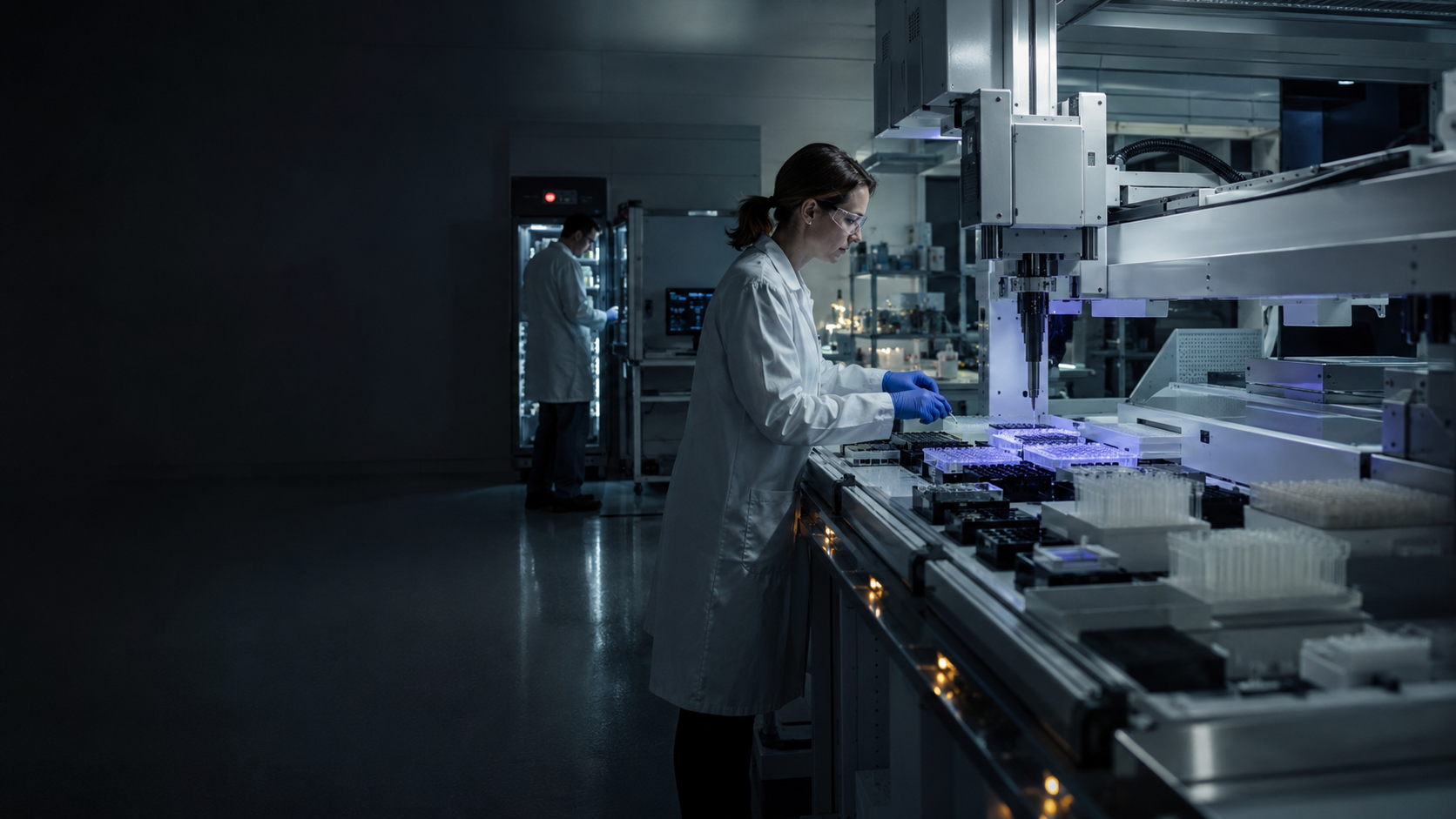
Anthropic said Monday that two of its Claude models — the invitation-only Mythos Preview and the publicly available Claude Opus 4.8 — independently designed hundreds of protein binders that worked when physically synthesized and tested, in a company-run study it's framing as early evidence its models can speed up drug discovery. Given fifteen target proteins, the models generated 1,320 candidate designs; wet-lab testing carried out by two independent partners, Adaptyv Bio and Twist Bioscience, confirmed 354 of them actually bound their targets, across 14 of the 15 targets attempted.
The headline figure is the hit rate: depending on setup, between 22.6% and 35.1% of Claude's designs bound to their target, against what Anthropic says is a typical 10% to 15% success rate for human-run protein-design campaigns today. Broken out by model and mode: Opus 4.8 hit 22.6% working across multiple targets at once, Mythos Preview reached 26.7% in that same multi-target mode, and Mythos Preview's own best showing, working one target at a time, was 35.1%. Some of the strongest designs bound several times more tightly than the best previously published result for their targets, by Anthropic's own account — the kind of claim that would normally need a peer-reviewed paper behind it, and doesn't have one yet.
“Protein minibinders are not a standard therapeutic modality” — Anthropic, stating its own study's limits.
The two models didn't perform identically, and the gap is the most interesting data point in the release. Against RBX1, a regulatory protein, Mythos Preview hit a 40% success rate working alone — compared with a 3.7% average among human entrants in a prior Adaptyv Bio design competition. But against TNFα, the inflammatory-signaling protein targeted by blockbuster drugs like Humira, it was Opus 4.8 that succeeded, producing 12 valid designs that bound the human, cynomolgus, and mouse versions of the protein, while Mythos Preview — nominally the more capable model — failed on that same target. (Anthropic said in the study it isn't sure why the less capable model succeeded where the stronger one didn't — a genuine unresolved question, not a detail it's glossing over.) Not every target cooperated at all: against maltose-binding protein, none of 90 designs was confirmed to bind.
Mythos Preview vs. Opus 4.8 on the same targets
| Mythos Preview invitation-only research preview | Claude Opus 4.8 publicly available model | |
|---|---|---|
| Multi-target hit rate | 26.7% | 22.6% |
| Best hit rate, single-target mode | 35.1% | Not reported at this rate |
| RBX1 result | 40% hit rate | Not the model used for this target |
| TNFα result | Failed to produce a valid binder | 12 valid cross-reactive designs |
A second, smaller part of the release tested a different skill entirely: reading lab instrument output. Given raw NMR spectra, Claude Opus 5 completed an analysis in 23 minutes that matched the human lab's own reading to within 0.08 parts per million; on a separate LC-MS run, it estimated compound purity at 96.4%, against the lab's own 96.33% figure. Neither result is a protein-design claim. It's a claim about reading and interpreting existing instrument data faster than a chemist would, not designing anything new.
What Anthropic itself says this isn't
Anthropic's own caveats are worth stating as plainly as the results. A designed protein binder is not a drug — it's the first of many steps a real therapeutic would need to clear, and the company says so itself rather than leaving a reader to assume otherwise. Anthropic also restricts access to its protein-design capability specifically over dual-use biosecurity concerns: the same modeling tools that design a therapeutic binder could, in principle, be pointed at something harmful, which is why the underlying tool stays gated rather than shipping as a product anyone can call.
For the two validation partners, the study doubles as a business signal. Twist Bioscience, a publicly traded DNA-synthesis company, and Adaptyv Bio, a startup that runs automated wet-lab validation as a service, are exactly the infrastructure a lab would need to actually use AI-designed binders at scale — and this is one of the more prominent public demonstrations either has had this year of a frontier AI lab paying to use that infrastructure directly.
Breaking the study into its individual claims is what actually separates what's checkable today from what is riding on Anthropic's word alone. That physical binders exist and were tested by outside labs is confirmed. How those results get characterized against the rest of the field is not.
- Claude's protein designs bound their targets at 22.6%-35.1%, beating a 10-15% industry baseline.
- Mythos Preview's 40% hit rate against RBX1 beats the 3.7% human-entrant average from a prior competition.
- A protein binder from this study could become an actual drug.
None of the numbers above are independently published research yet. They come entirely from Anthropic's own account of a study Anthropic designed and ran, with two outside labs providing physical validation rather than the outside peer review a claim like this would normally need. That distinction is the whole gap between "Claude can accelerate drug discovery" and "Claude produced striking numbers in a company-run pilot" — and right now, only the second sentence is something an outsider can actually check for themselves.
- Anthropic says Claude models designed protein binders that worked in independent lab tests.
- Hit rates ran 22.6% to 35.1%, versus a typical 10-15% baseline Anthropic cites for the field.
- Adaptyv Bio and Twist Bioscience physically tested the designs — this wasn't simulation alone.
- One model failed a target the other succeeded on, and Anthropic says it doesn't know why.
- Caveat: this is Anthropic's own self-run study, not yet independently peer-reviewed, on non-drug binders.