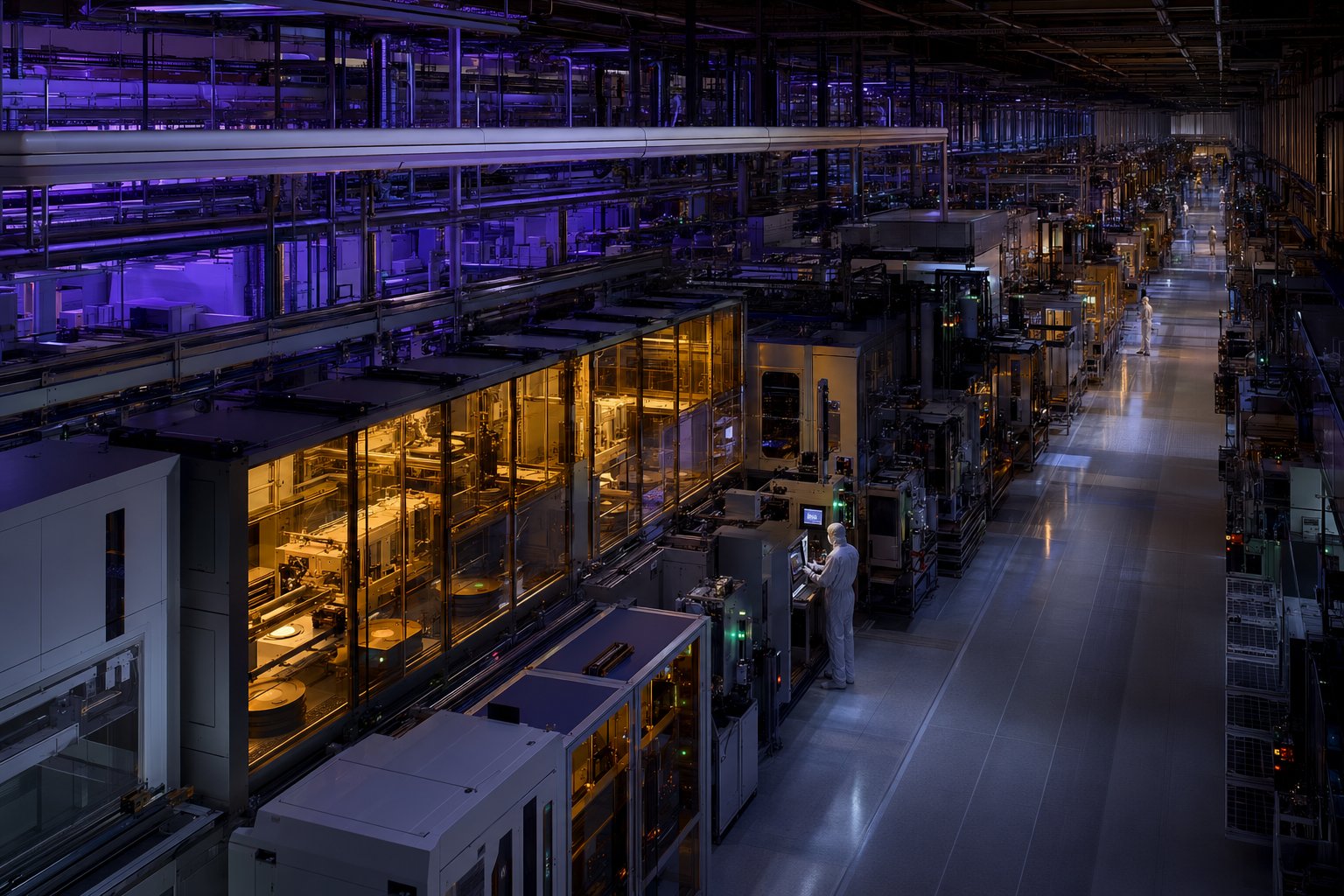
ASML reported record third-quarter revenue of 11.66 billion euros on Wednesday, beat its own prior guidance, and raised its full-year 2026 outlook to 44-45 billion euros -- and then told investors the good quarter doesn't change the underlying problem. Chief executive Christophe Fouquet said plainly in the earnings release: "our supply as currently planned for both 2027 and 2028 will not fully meet the demand of our customers." Some customers, he added, are now placing orders for 2029 and even 2030 -- delivery windows that are normally years away from being discussed, let alone booked.
The numbers behind the record quarter are straightforward. Net income reached 4.96 billion euros on a 57.5% gross margin, up from 54.0% on 9.33 billion euros of net sales the quarter before; ASML sold 113 new lithography systems and 8 used ones, closed the quarter with 12.74 billion euros in cash, and guided Q4 revenue to a range of 14.2 to 15.2 billion euros. It also repurchased 4.1 billion euros of its own shares in the quarter under its 2026-2028 buyback program and will pay an interim dividend of 1.88 euros per share on November 4. None of that is the actual news. A company beating guidance and raising its outlook is routine; a monopoly supplier telling its own customers it cannot build enough of its product for two years running is not.
The quarter, scoped
- €11.66B · Q3 2026 net sales
- A record quarter, per ASML's own release
Includes: All ASML systems sold and serviced in the quarter, new and used, across all customers
Excludes: Bookings/order intake for future quarters -- ASML did not disclose a specific Q3 bookings figure - €44-45B · Full-year 2026 guidance
- Raised from the prior range
Includes: ASML's own forward guidance, confirmed alongside Q3 results
Excludes: Any 2027 or 2028 revenue commitment -- those years are described only in capacity and demand terms, not sales guidance - "Will not fully meet" · 2027-2028 demand, per CEO Fouquet
- ASML's own characterization of its supply gap
Includes: Planned EUV output as currently committed for 2027 and 2028
Excludes: A quantified shortfall -- ASML did not state a specific unit gap between planned supply and demand
The quarter-on-quarter jump is the plainest evidence that demand hasn't eased.
Quarterly net sales, 2026
This is not a new complaint from ASML -- it is the same bottleneck getting visibly worse. In July, after its Q2 results, ASML raised its 2026 guidance for the first time to this 43-45 billion euro range and began pressing its largest customer, TSMC, for higher prices on both its most advanced EUV tools and its older DUV systems, on the logic that a sole supplier that is effectively sold out through 2027 has no reason to keep prices where they were. TSMC resisted the increase at the time; some Chinese customers agreed to pay it. Wednesday's results confirm that the "sold out" framing from July wasn't a negotiating position -- it was accurate, and it has since extended a full year further, into 2028.
ASML's own response has been to speed up, not just to expand. Chief financial officer Roger Dassen has described cutting the time from production start to shipping on its EUV machines from roughly 22 weeks a few quarters ago toward a target of 15 to 16 weeks, by trimming testing protocols while holding quality, shifting cleanroom space from research to production, and working with suppliers to clear component bottlenecks. That is a company trying to manufacture its way out of a shortage it cannot simply build new factories to fix in time -- EUV machines are custom-engineered, multi-story installations years in the making, not a product line that scales by adding a shift. The company expects to produce roughly 65 of its low-NA EUV systems this year, and has already committed to a 30% capacity increase on top of that for 2027 -- which, by that arithmetic alone, is still, per Fouquet's own account, short of what customers want.
It is worth being explicit about why one Dutch company's production schedule is a story about artificial intelligence at all. Every frontier AI model, from the largest labs to the smaller challengers, ultimately runs on chips fabricated at a small number of leading-edge foundries -- and every one of those foundries' most advanced nodes depends on EUV tools that only ASML makes. A GPU shortage usually reads, in the press, as Nvidia's problem or a hyperscaler's procurement headache. This earnings call is the reminder that the actual physical constraint sits one layer further upstream, at a single company whose 2026 output, record quarter included, still isn't enough -- which means the pace of the AI buildout through 2028 is, in a very literal sense, already decided by a production schedule ASML published this week, not by how much capital any AI lab or cloud provider is willing to spend.
- Every leading-edge chip any of the three ships depends on EUV tools only ASML makes; a 2027-2028 shortfall means some planned node transitions slip, regardless of how much capital any foundry is willing to spend.
- A sole supplier facing demand it cannot fill is a company with pricing power it has already started to use, on top of a record quarter and an active buyback.
- The pace of the entire AI buildout is gated by how fast the three foundries above can get leading-edge capacity -- which is in turn gated by ASML's tool deliveries, a dependency most AI capex announcements don't mention.
“Our supply as currently planned for both 2027 and 2028 will not fully meet the demand of our customers.” — Christophe Fouquet, CEO of ASML, Q3 2026 earnings release
Fouquet's own hedge is worth reading precisely: ASML is "investigating ways to increase capacity for 2028 beyond the 30% increase we previously communicated," not committing to one. That is a company studying a bigger expansion, not announcing it -- the distinction between the two is exactly where a reader should watch next. Capacity expansion at this scale means new assembly lines for a machine with roughly 100,000 parts, built by a workforce ASML has to train as fast as it hires; it is not a decision that converts into shipped tools inside a single quarter, however strong this one was.
- ASML posted record Q3 2026 revenue of 11.66 billion euros, beating its own prior guidance range.
- CEO Fouquet says planned 2027 and 2028 EUV supply still won't fully meet customer demand.
- Some customers are now placing orders for 2029 and 2030 delivery, a rare multi-year lead time.
- ASML is the sole maker of EUV machines; TSMC, Samsung and Intel all depend on its output.
- Caveat: a further 2028 capacity increase is under study, not yet committed to or quantified.