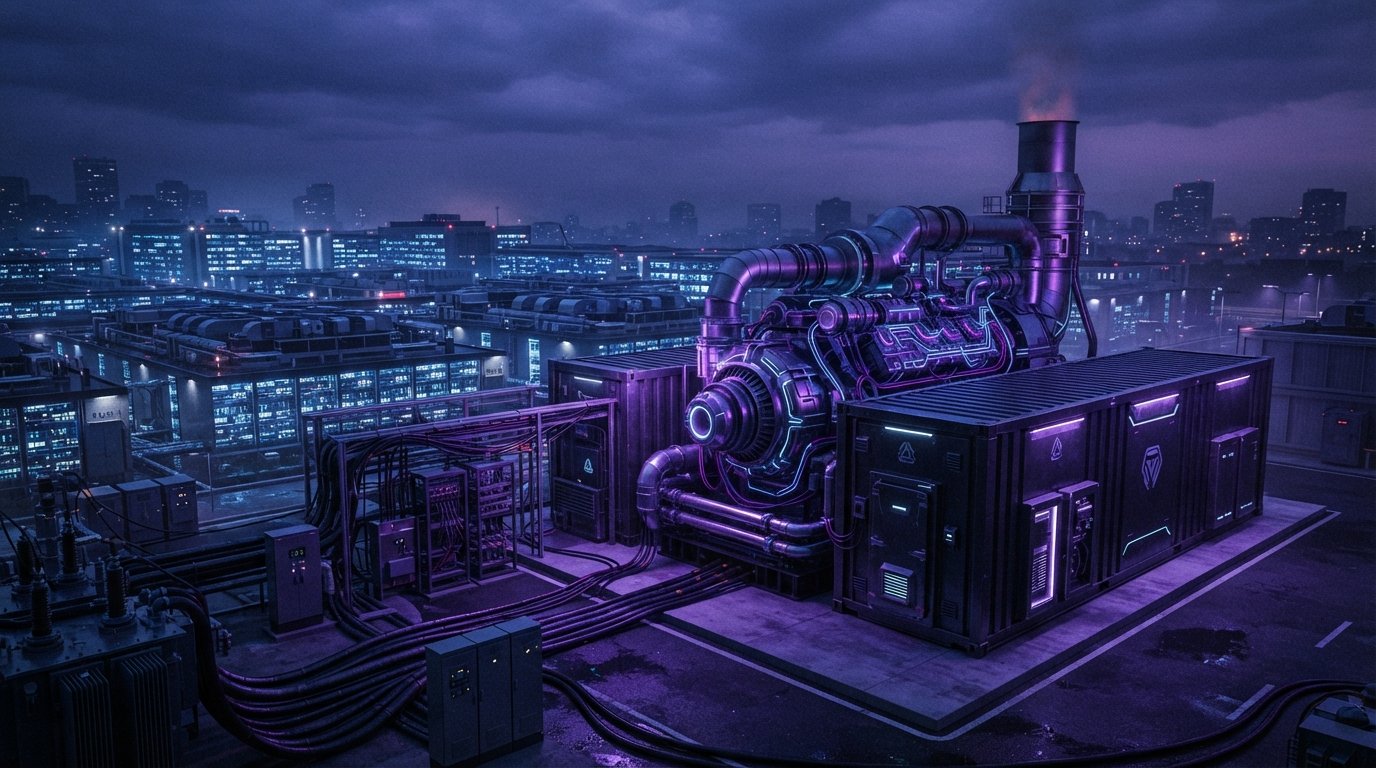
Crusoe has canceled a $1.25 billion order for 29 of Boom Supersonic's jet-derived power turbines, nine months after signing on as Boom's launch customer for a business it was betting would help fund its supersonic-jet program on the side. The reversal lands eight days after Crusoe closed a $3.9 billion funding round, so this wasn't a company short on cash walking away from a bill it couldn't pay. Boom CEO Blake Scholl announced the split on X, writing that turbines are "no longer part of Crusoe's near term primary power mix at Abilene/etc., so a launch partnership just didn't make sense." A Crusoe spokesperson, Andrew Schmitt, told reporters the company still wants turbines -- "just not Boom's" -- as part of a mix that now includes wind, solar, batteries, turbines and the grid, decided site by site rather than locked to one supplier.
The deal was, at signing, a genuine bet on a new category. Boom -- known for the Overture supersonic airliner, with 130 aircraft on order from United, American and Japan Airlines -- announced on Dec. 9, 2025 that it was repurposing the high-pressure engine core it built for supersonic cruise into a stationary 42-megawatt natural-gas turbine called Superpower, marketed as running at full output above 110°F and needing no water -- both real constraints for data centers sited away from reliable grid capacity. Crusoe signed on as launch customer for 29 units, a $1.21-gigawatt order, alongside a $300 million Series B Boom raised to build them.
What the $1.25 billion actually committed to
- $1.25B · Crusoe / Boom
- Order for 29 Superpower turbines
Includes: The turbine units themselves, 42MW / 1.21GW total, shipping-container packaged
Excludes: Site prep, interconnection, land, fuel supply, and O&M -- none disclosed as part of the figure - $300M · Boom Series B
- Boom's own raise to build the Superpower business
Includes: Announced alongside the Crusoe order, led by Darsana Capital Partners
Excludes: Any Crusoe capital -- this was Boom's fundraise, not Crusoe's investment in Boom - $3.9B · Crusoe Series F
- Crusoe's own raise, closed Sept. 17, 2026
Includes: A $30.9B post-money valuation
Both men said the launch partnership mattered at the time. "We're proud to be partnering closely with Boom as the launch customer for Superpower," Crusoe CEO Chase Lochmiller said in the December announcement. Scholl called supersonic engine technology "an accelerant -- of course for faster flight, but now for artificial intelligence as well." Nine months later, Scholl's own announcement of the split briefly used, then removed, the line about turbines no longer fitting Crusoe's near-term plans -- before he pivoted to congratulating Cavness and Lochmiller on Crusoe's new raise and wishing the companies well if the fit ever returns.
“Turbines are no longer part of Crusoe's near term primary power mix at Abilene/etc., so a launch partnership just didn't make sense.” — Blake Scholl, Boom Supersonic CEO, announcing the split
- Boom's launch customer for Superpower
- Crusoe's committed turbine order
- Crusoe's stated power mix at Abilene
- First Superpower deliveries to Crusoe
Crusoe's own account of Abilene undercuts any read of this as a sudden retreat from turbines generally. Its 1.2-gigawatt Oracle/OpenAI campus there already runs on the grid with gas turbines as backup only; a separate 900-megawatt Microsoft-anchored site on the same campus uses on-site gas turbines directly. The company's own description of its approach -- battery storage "to ensure reliability," wind and solar for "economic and carbon optimization," turbines as backup -- reads as a company that was already treating power sourcing as a per-site optimization problem, not a single long-term supplier relationship. Boom's Superpower business was a bet that Crusoe would centralize around one; Crusoe's answer, nine months in, is that it won't.
The turbine question exists at all because grid interconnection for a gigawatt-scale campus routinely takes years longer than the AI industry's own build timelines -- which is exactly the gap Boom's pitch was built to fill: a shipping-container-packaged 42-megawatt unit, buildable off Boom's existing Symphony jet-engine supply chain rather than a years-long turbine-manufacturer order queue. What Crusoe's reversal adds to that picture isn't that on-site generation is a bad idea -- its own Microsoft-anchored Abilene building still runs on it -- it's that even the specific vendor and technology chosen for it, a year into a signed order, turned out to be as negotiable as any other line item, in a way land, cooling and chip supply generally aren't allowed to be once a campus is under construction.
- Dec. 9, 2025 — Boom announces the Superpower turbine and Crusoe as launch customer, a $1.25B order alongside Boom's own $300M raise
- Early 2026 — Crusoe separately pauses a planned AI campus in Wyoming
- Sept. 17, 2026 — Crusoe closes a $3.9B Series F at a $30.9B valuation
- Sept. 25-26, 2026 — Boom's CEO announces the turbine partnership has ended; Crusoe says it still wants turbines, just not Boom's
Laid out that way, the sequence reads less like a single bad fit and more like a company still actively re-pricing its own infrastructure bets in real time, even while its balance sheet gets stronger. That's the part worth separating from the Boom-specific drama: the $3.9 billion raise and the $1.25 billion cancellation are not in tension with each other financially -- Crusoe clearly isn't short of capital -- which means the reversal was a judgment about the turbines and the vendor, not about affordability.
(Boom's Superpower pitch was never just about data centers -- turbine profits were explicitly earmarked to help fund the Overture supersonic jet's certification program. Losing its largest named power customer doesn't touch Overture's 130-aircraft order book directly, but it does remove the cross-subsidy Boom's own executives had built into the plan.) For the AI-infrastructure buildout broadly, the more durable lesson may be less about Boom specifically and more about how little of this market has actually settled: even a company that just closed one of the largest AI-infrastructure raises of the year treated a year-old, publicly announced, gigawatt-scale power commitment as changeable rather than load-bearing.
That's a harder problem for smaller turbine and generation vendors than for Crusoe. Crusoe can absorb a canceled order and shop for a new one from a position of fresh capital; a launch-customer relationship walking away nine months in is a much bigger hit to a young hardware manufacturer's own backlog, financing story and supplier negotiations than to the buyer's build schedule. Boom's public statement papers over that asymmetry with warmth toward Crusoe's founders and its own unchanged 2027-2028 targets -- worth remembering the next time a vendor's own announcement of a canceled deal reads more like a breakup text than a business update.
- Crusoe canceled its $1.25 billion order for 29 of Boom Supersonic's 42-megawatt turbines.
- Boom's CEO says turbines are no longer part of Crusoe's near-term power mix at Abilene.
- The reversal came eight days after Crusoe closed a $3.9 billion round at a $30.9 billion valuation.
- Crusoe says it still wants turbines -- 'just not Boom's' -- alongside wind, solar, batteries and the grid.
- Caveat: neither company has named a replacement supplier or a dollar figure for the gap this leaves.