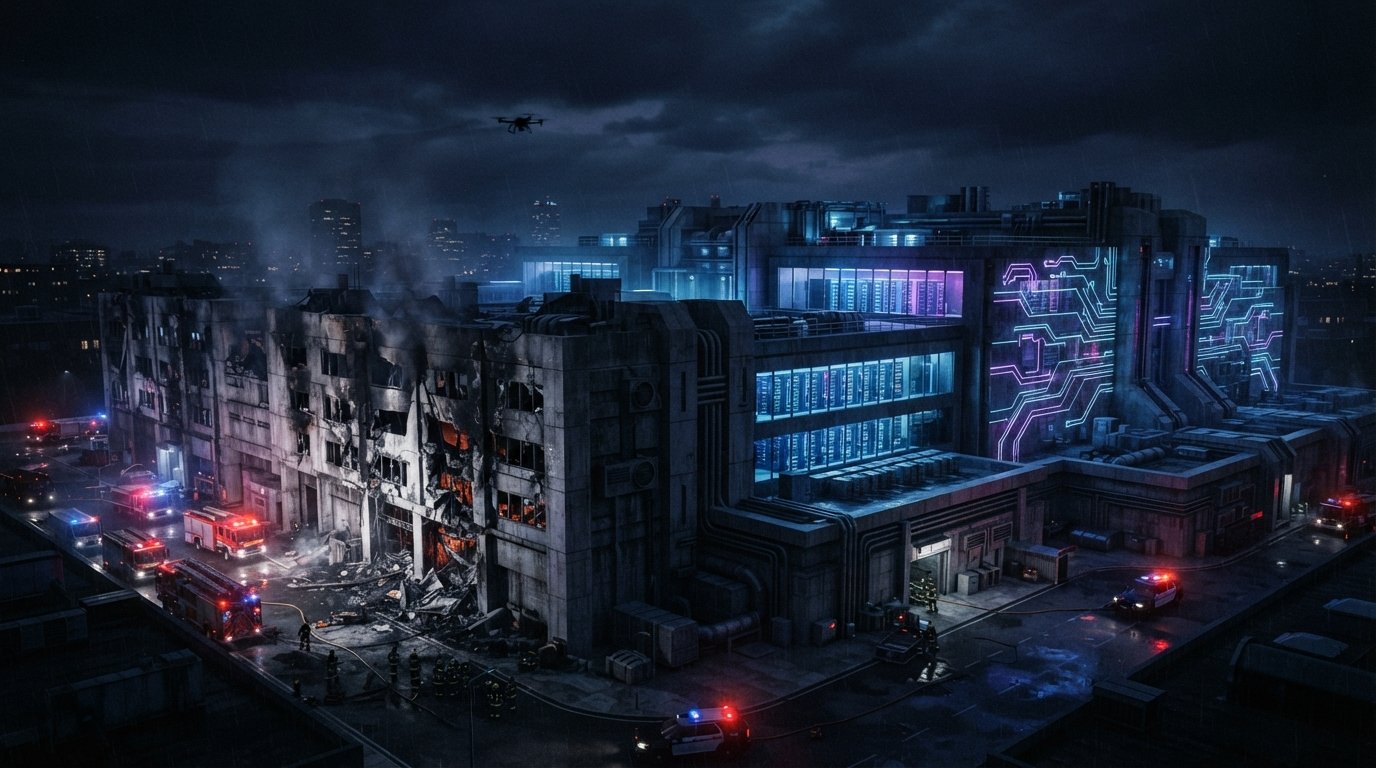
Three Ukrainian drone strikes in four days have hit the only three sites where Yandex houses the supercomputers it uses to train its AI models, the Russian search and cloud giant has confirmed. A strike on the company's Sasovo data center on October 8 was followed by one on its Kaluga facility the next day, then a third on its Vladimir site on October 11. Yandex says the Sasovo and Vladimir centers are fully shut down; Kaluga is running in a degraded state. Russian tech outlet T-Invariant reported October 11, citing unnamed experts, that all three of Yandex's AI-training supercomputers may now be offline -- a claim Yandex has not confirmed or denied.
Yandex's own account of each strike is specific enough to be checked. At Sasovo -- operating since 2014 -- the company said "some of its services may be unavailable" as a fire took the site fully offline; Yandex shares fell more than 3% on the Moscow Exchange within the hour, and outages reached Yandex Cloud, Yandex Disk and Yandex Documents, plus third-party users including the property site Cian and Russian Railways. Ukrainian president Volodymyr Zelensky, asked about the strike, said only, "We always respond in mirror-like fashion" -- not a claim of responsibility, and Ukraine has not officially claimed credit for any of the three strikes individually.
Three strikes, four days
- Oct 8, 2026 — Drone strike starts a fire at Yandex's Sasovo data center (Ryazan region); site fully shut down.
- Oct 9, 2026 — Drone strike partially disables Yandex's Kaluga data center, the company's largest.
- Oct 11, 2026 — Drone strike fully shuts down Yandex's Vladimir data center; residents nearby evacuated.
- Oct 11, 2026 — Russian outlet T-Invariant reports all three of Yandex's AI-training supercomputers may now be down -- unconfirmed by Yandex.
The Kaluga site, in the Grabtsevo industrial park, is what Yandex itself describes as its largest data center and one of the biggest in Russia; the company said only that "several modules" were disabled, with no count given. Two days later, a drone hit Yandex's newer Vladimir facility -- a 40-megawatt, 2,800-server-rack site that opened in March 2026 alongside the company's original 2017 building there. The regional governor confirmed the strike and a resulting fire, and nearby residents were evacuated; no injuries were reported at any of the three sites. Yandex's own status updates described the site as running in emergency mode and told customers to activate their own disaster-recovery plans -- advice that implies no restoration date, not just that one hadn't been announced yet.
What's actually known, site by site
- Fully shut down · Sasovo, Ryazan region
- Houses 2 of Yandex's 3 AI-training supercomputers
Includes: Chervonenkis and Lyapunov, per Yandex's own 2021 announcement naming both systems' location
Excludes: Confirmation of whether the supercomputers themselves were damaged, versus just power or building systems - Partially disabled · Kaluga region
- Yandex's largest data center
Includes: "Several modules," per Yandex's own statement
Excludes: A specific count of servers or modules affected - Fully shut down · Vladimir
- Houses Yandex's 3rd AI-training supercomputer, Galushkin
Includes: A 40MW, 2,800-rack facility opened March 2026, alongside the original 2017 site
Excludes: Confirmation of damage to the newer versus older building specifically
The reason three outage reports add up to one story is a detail Yandex itself published in 2021: Sasovo is where it placed Chervonenkis, its most powerful machine and then the 19th-ranked system on the global TOP500 list, alongside a second system, Lyapunov; Vladimir is where it placed the third, Galushkin. All three exist to train the neural networks behind Yandex's AI products, not to run its ordinary cloud business. That is the specific claim T-Invariant's October 11 report makes -- that the Ukrainian strikes have now reached every site hosting one of those three systems -- and it is also the specific claim that remains unconfirmed by the one party that would actually know.
What's established, what's still a claim
- Drone strikes hit Yandex's Sasovo, Kaluga and Vladimir data centers on Oct. 8, 9 and 11.
- All three of Yandex's AI-training supercomputers (Chervonenkis, Lyapunov, Galushkin) are now offline.
- Yandex has no fixed timeline for full restoration.
Rebuilding, if the supercomputers really are down, is not mainly a construction problem. All three systems run on Nvidia A100 GPUs -- hardware the United States restricted from export to Russia in 2022, well before the newer H100 ban that followed. Experts T-Invariant consulted said the sites were built for peacetime, in regions with no history of drone threat, so physical hardening was never a priority; the harder constraint on any rebuild is the same gray-market import pipeline Russian firms have relied on since 2022 to bring in sanctioned chips at all, which neither moves fast nor moves at the volumes a supercomputer rebuild would need. (Russia's remaining heavy machine-learning capacity -- Sberbank's Christofari Neo and the telecom operator MTS's GROM system -- sits closer to Moscow, which has denser air defenses than Ryazan, Kaluga or Vladimir.)
- If the supercomputer damage is real, the training runs that depended on them are delayed for as long as sanctioned-chip replacement takes -- which experts say is the harder constraint, not the physical rebuild.
- Services from Cian to Russian Railways to regional government sites have already gone down as collateral effects of strikes aimed at the AI infrastructure specifically.
- Three strikes in four days reaching every site tied to Yandex's AI training, whoever conducted them, is a materially different result than three strikes on arbitrary data centers.
- Better air defenses around the capital may or may not hold if the campaign continues -- there is no public evidence yet either way.
“We always respond in mirror-like fashion.” — Volodymyr Zelensky, President of Ukraine, asked about the Oct. 8 strike on Yandex's Sasovo site
The pattern these strikes fit is a reciprocal one: Russia has struck Ukrainian data centers and telecom facilities repeatedly over the past month, including targets in central Kyiv, and Zelensky's framing -- responding "in mirror-like fashion" -- describes a tit-for-tat campaign against digital infrastructure on both sides rather than a one-off operation. What makes the Yandex strikes specifically notable is precision, not scale: of everywhere in Russia these drones could have reached, all three hit sites that, per Yandex's own public record, exist to train its AI models. Whether that is coincidence, degraded aim, or the actual target list is not something either government has stated on the record.
It is worth being precise about which Yandex this is. The company spun off its international business -- including the cloud unit that now trades independently as Nebius on Nasdaq -- in 2024, severing it from the Russia-based parent. (Nebius operates independently today and has no ownership link to the struck sites; this newsroom has covered its own, separate compute deals, including a 2026 sale of more than $1 billion in capacity to Reflection AI.) The company hit this week is the domestic remainder: Russia's largest search engine and cloud provider, and -- per its own 2021 announcement -- the home of the country's most powerful AI-training hardware. That distinction matters because it is domestic Yandex, not Nebius, whose infrastructure decisions sit closest to the Russian government and whose recovery options are most directly shaped by US and EU export sanctions.
- Ukrainian drones hit three Yandex data centers in four days: Sasovo, Kaluga, then Vladimir.
- Those three sites house all three supercomputers Yandex uses to train its AI models.
- Russian outlet T-Invariant reports all three may now be down; Yandex hasn't confirmed that.
- Yandex says services are gradually recovering; its own status page gives no fixed timeline.
- Caveat: experts say sanctions-driven chip shortages, not physical repairs, may slow rebuilding most.