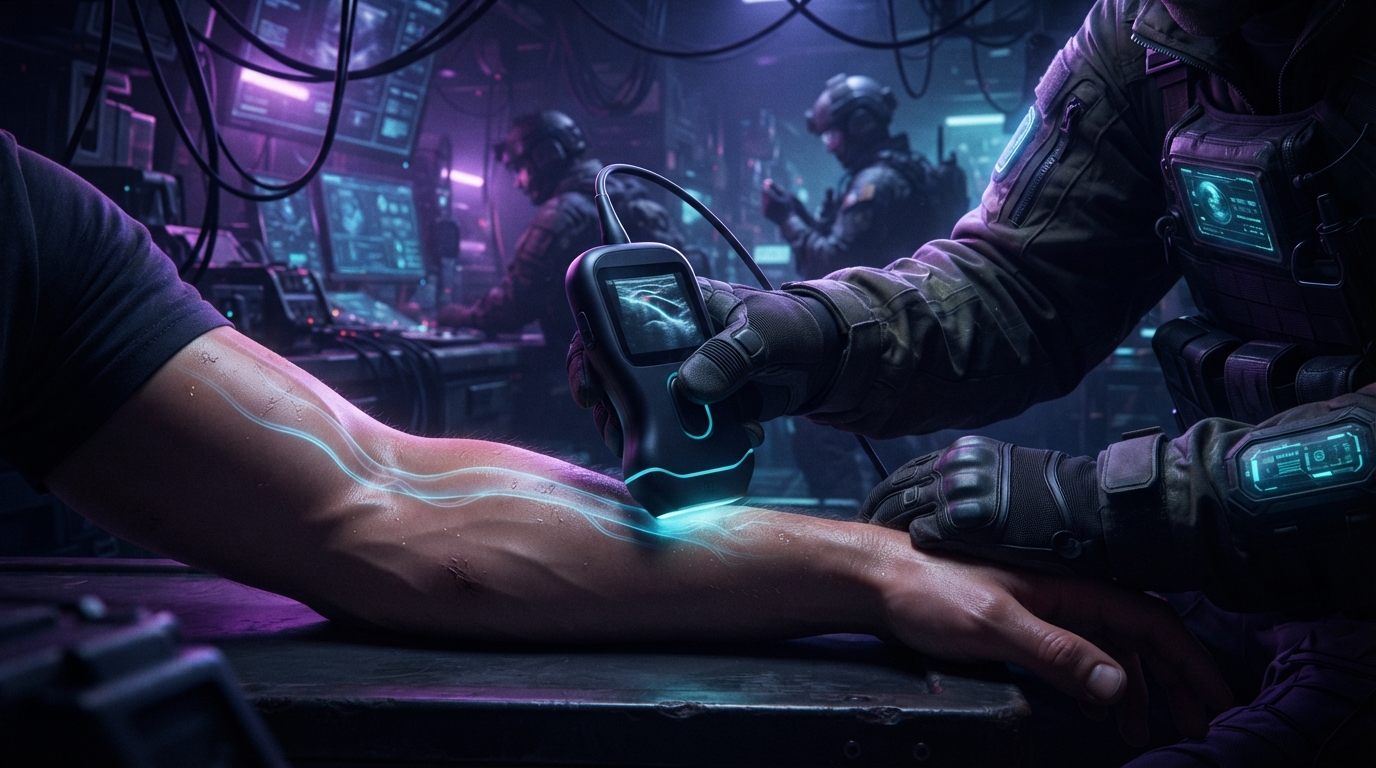
A handheld device that pairs a commercial ultrasound probe with custom AI software just won the Federal Laboratory Consortium's 2026 Excellence in Technology Transfer Award -- recognition for research that made it from a lab bench to a real commercialization path. AI-GUIDE, built by MIT Lincoln Laboratory and Massachusetts General Hospital with funding from the US Army's Combat Casualty Care Research Program, is designed to let a minimally trained user -- a combat medic, not a vascular specialist -- guide a needle and catheter into a patient's deep artery or vein using AI-assisted ultrasound guidance.
The device, in short
- Built by
- MIT Lincoln Laboratory + Mass General Hospital
- Funded by
- US Army Combat Casualty Care Research Program
- Award
- FLC 2026 Excellence in Technology Transfer
- FDA status
- Breakthrough Device Designation
- Commercial partner
- AutonomUS Medical Technologies
The clinical need it targets is specific: getting a large-bore line into a deep vessel usually requires a trained specialist reading an ultrasound image in real time, a skill most combat medics and many civilian first responders don't have. AI-GUIDE's software interprets the ultrasound feed itself and helps steer the needle to the right vessel, so the device -- not years of training -- carries most of the expertise. Lincoln Laboratory says the goal is a medic in the field keeping a severely injured patient stable for the hours, sometimes days, before evacuation to a hospital is possible.
“This recognition reflects what effective technology transfer looks like -- aligning the Army's operational need with Mass General's clinical expertise and Lincoln Laboratory's engineering capabilities to deliver a solution with a clear path to impact,” said Asha Rajagopal, the lab's chief technology transfer officer. The device has already cleared one regulatory hurdle: the FDA granted it Breakthrough Device Designation, a fast-track review status reserved for technologies the agency judges could meaningfully improve treatment of life-threatening conditions -- a designation that speeds review but is not itself a clearance to sell.
AutonomUS Medical Technologies, the startup now handling commercialization, has not disclosed a shipping product, price, or clearance timeline. The award marks a research milestone, not a market one -- the device that could let a medic without specialist training save a bleeding patient's life is still, for now, a prototype in transfer, not a product on a shelf.
- AI-GUIDE helps a minimally trained user place a catheter in a deep artery or vein.
- MIT Lincoln Laboratory and Massachusetts General Hospital built it with US Army funding.
- It won the Federal Laboratory Consortium's 2026 Excellence in Technology Transfer Award.
- It holds FDA Breakthrough Device Designation and is being commercialized by AutonomUS Medical Technologies.
- Caveat: no cleared, shipping commercial product exists yet -- it remains a prototype in transfer.