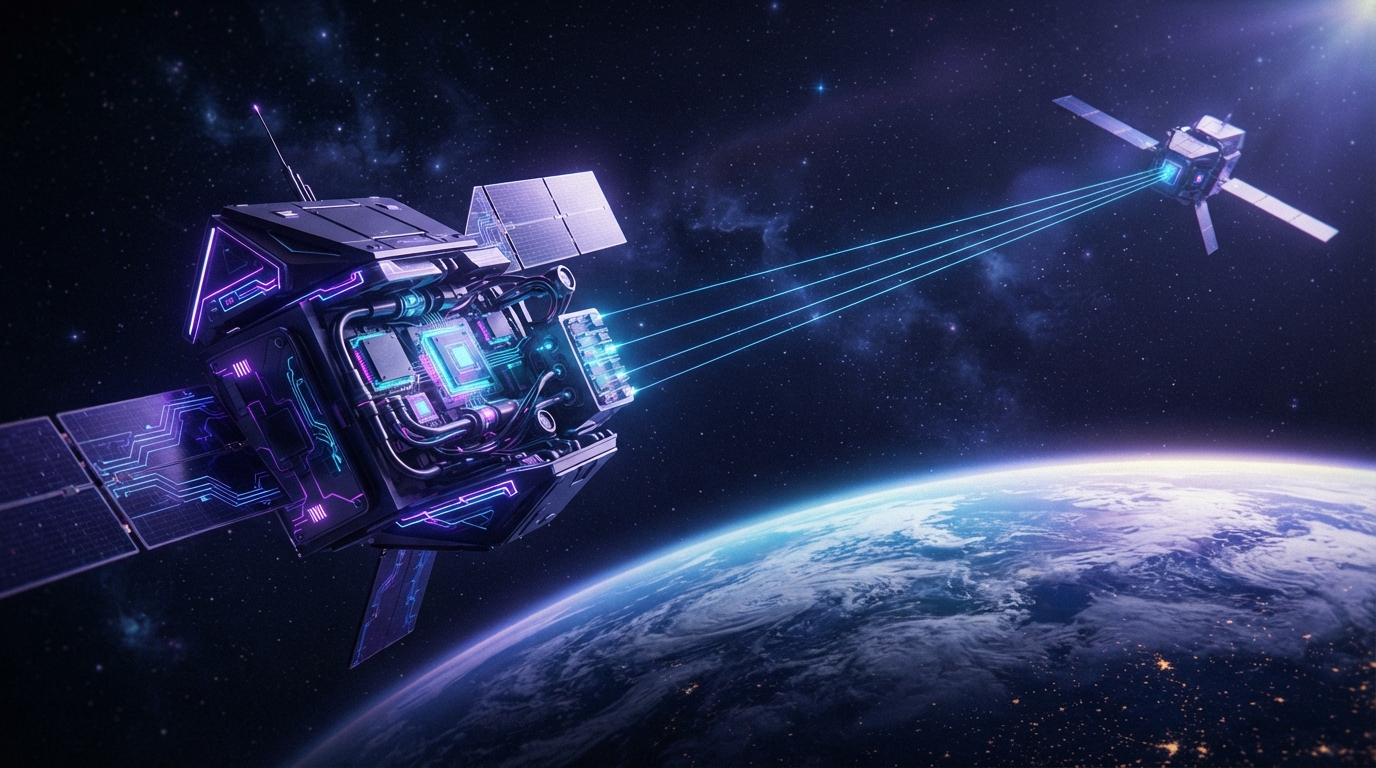
A SpaceX rocket lifted a refrigerator-sized satellite into a sun-synchronous orbit on Wednesday, carrying four of Google's Trillium TPU chips on a mission the company is calling Project Suncatcher. Built with the satellite manufacturer Planet, the spacecraft is Google's first real hardware test of an idea it has been describing in papers and blog posts since November 2025: that AI compute run on solar-powered satellites, linked by lasers, could one day be cheaper and more abundant than anything built on the ground. Nothing about Wednesday's launch proves that yet -- by Google's own account, it proves only that the chips survived the trip.
"As a first step, we tried to find reasons that it was impossible, but we gradually became convinced that it might actually work," Beals has said of the project's origin -- a description that doubles as the honest caveat running through everything Google has published about it since: this is a team that set out to disprove its own idea and didn't quite manage it, not one that set out to build a product.
Google is framing Suncatcher the way it frames its other long-shot research arcs -- the ones that produced Waymo's self-driving cars and its quantum-computing program -- rather than as a product roadmap. That framing matters, because the news here isn't that space-based AI computing suddenly works. It's that the company willing to spend the most on terrestrial AI data centers just told investors, in public, exactly how far away its own backup plan actually is, and then flew the hardware anyway. Three rival efforts -- a well-funded startup, a satellite-data-center operator, and the world's dominant AI-chip maker -- are moving faster and claiming more, which makes Google's caution the most useful data point in the whole story, not the launch itself.
The satellite carries four Trillium (TPU v6e) chips, a laser cross-link payload, and a solar array sized to feed them -- Google says a panel in the right orbit can be up to eight times more productive than the same panel on Earth, with power available nearly continuously rather than cycling through weather and nightfall. The chips will run Google's open-weight Gemma model during the test, according to reporting on the launch, flying in a dawn-dusk sun-synchronous low-Earth orbit chosen specifically to keep the solar panels lit almost all the time. Planet operates the bus; Google supplies and monitors the compute payload. The mission is planned to run for about a year.
The headline constraint is heat, not power. A satellite radiator can reject roughly 300 watts per square meter into space; a modern AI accelerator under load dissipates power at roughly 333 times that density. Google's own math on the problem works out to needing about 1.3 square meters of radiator area per chip -- a geometry problem, not an energy one, and the direct reason the chips in this test run for only 15 minutes at a stretch before they have to idle and cool. That 15-minute duty cycle is the single most concrete number this launch actually produces: everything else about Suncatcher's economics is downstream of how fast engineers can shrink that radiator-to-chip ratio.
"I don't see this being something where it's cheaper to do this in the next five years." -- Travis Beals, Project Suncatcher lead, Google
Beals frames the appeal in almost elemental terms: "the sun puts out almost all of the power in our solar system," he has said. "All of the other power sources that humanity has tapped into are just a tiny fraction of a percent." The entire project is a bet on capturing a sliver of that rather than continuing to compete for gigawatts on an already-strained terrestrial grid. He's also been candid that the unglamorous part of the problem -- what to do with the waste heat once you've caught that power -- is "a crucial research challenge" in its own right: the radiators needed to wick heat away are already one of the heaviest components on this mission, which is a real cost problem given that heavier satellites are more expensive to launch. That candor is itself notable: companies pitching a moonshot rarely lead with the part they haven't solved yet.
Before launch, Google ran the Trillium chips through a 67 MeV proton beam at UC Davis's Crocker Nuclear Laboratory to see how they'd hold up to five years of space radiation, modeled at a shielded dose of 750 rad(Si). The TPU logic itself showed no hard failures all the way up to 15 krad(Si) -- a 20x margin over the mission requirement. The weak point was HBM, the high-bandwidth memory stacked next to the compute die: it started showing irregularities at 2 krad(Si), still nearly three times the five-year dose but a far thinner safety margin than the logic itself. Testing also turned up one silent data-corruption event during beam exposure; Google says most radiation-induced bit flips were recoverable with a simple restart, which is a very different statement from "the hardware is rated for space."
The bigger vision depends on a second unproven piece: getting satellites to talk to each other fast enough to act like one data center instead of four isolated chips. Google's bench demonstration hit 800 Gbps in each direction over a single optical transceiver pair -- 1.6 Tbps combined -- using the same dense wavelength-division-multiplexing hardware that undersea cables use, but the full vision needs tens of terabits per second per link, and satellites would need to hold formation within a kilometer or less of each other to make the optics work at all. Google's modeled end state is a cluster of 81 satellites at roughly 650 km altitude, with next-neighbor spacing oscillating between 100 and 200 meters inside a 1 km radius -- a flying formation nobody has sustained at this scale, Google included.
Independent analysts reading the same paper put that specific piece in blunter terms than Google does in its own copy: formation flight at 100-meter spacing has never been sustained at this scale by anyone, and guidance, navigation, and control across an 81-satellite lattice is, in the phrase one outside technical review used, uncharted engineering territory. That is the honest way to describe the gap between "we modeled a cluster" and "we flew a cluster." Wednesday's satellite tests none of it -- it carries no second spacecraft to link with, so the formation-flying and inter-satellite laser questions stay exactly where they were before launch, deferred to the two-satellite mission Google has scheduled for early 2027.
What has to change for orbital compute to pencil out
Google's own economics paper says an orbital data center's running costs "could become roughly comparable" to a terrestrial one's -- but only once launch prices fall from today's roughly $3,600 per kilogram on a reusable Falcon 9 to under $200 per kilogram, and only by the mid-2030s at the earliest. That is an 18x drop, and Google's own framing of how to get there is blunt: it requires sustained high-volume Starship flights on a steep enough learning curve, not a one-time efficiency gain. Nothing in Google's own materials claims that price is close; it is a target the whole plan is contingent on, not a forecast of when it arrives.
Orbital infrastructure still costs far more than off-grid terrestrial capacity
That 4.5x premium is why the pitch for orbital compute isn't "cheaper than a data center" today -- it's "cheaper than not being able to build a data center at all." Grid-interconnection queues have already pushed over a third of planned US data centers off-grid onto their own power generation, and the analyst firm Futurum estimates that constraint alone could justify roughly $1 trillion of orbital AI capex by 2030 -- a projection, not a measured figure, and one no second analyst firm has yet corroborated. The case for space, in other words, isn't primarily about watts. It's about not waiting years in a transmission-line queue for the watts you've already paid for. Futurum's own off-grid cost figures tell the same story from the terrestrial side: a fully off-grid AI factory is projected to rise from roughly $35 billion per gigawatt in 2025 to $43 billion by 2030, even before anyone leaves the ground -- the baseline Suncatcher has to beat is itself getting more expensive, not staying fixed.
A narrower, separate estimate is worth distinguishing from Futurum's trillion-dollar figure rather than conflating with it: industry tracker Introl pegs the specific in-orbit data center market -- the hardware and services segment, not total AI capex enabled by it -- at roughly $1.77 billion by 2029. Both numbers can be true at once because they measure different things, the same way a company's market capitalization and its annual revenue aren't the same figure; Futurum is sizing a macro shift in where AI compute gets sited, Introl is sizing the orbital-hardware line item inside it. Neither is a measured result yet -- both describe a market that, as of Wednesday, consists of one Google test satellite, one Starcloud GPU, and two Axiom Space nodes.
Google is also not alone, and it isn't even first. Starcloud put an Nvidia H100 into orbit in November 2025 and trained a small model on it using nothing but solar power; the company raised a $170 million Series A at a $1.1 billion valuation in March 2026 (Starcloud says that made it the fastest startup to reach unicorn status in Y Combinator's history -- roughly 17 months from its demo day.) and plans a full Nvidia Blackwell cluster on a second satellite, Starcloud-2, in 2027. Axiom Space and Kepler Communications already have two commercially operated data-center nodes running in low Earth orbit, launched in January 2026 on multi-GPU hardware linked by a 2.5 Gbps optical relay network built to Space Development Agency standards. And at its March 2026 developer conference, Nvidia previewed a chip system called Vera Rubin Space-1, purpose-built for the power and thermal limits of a satellite, claiming up to 25 times an H100's AI performance -- with Axiom Space, Starcloud, and Planet all named as early partners.
Starcloud -- founded in 2024 as Lumen Orbit before rebranding -- says it got that first H100 into orbit for roughly $2 million, against a reported $75-100 million quote it had received from a traditional aerospace prime for the same job; it hit that number by flying automotive-grade components it had radiation-tested in a terrestrial particle accelerator rather than paying for space-qualified parts. The company has since filed with the FCC for a constellation of up to 88,000 satellites operating at 650-800 km altitude -- a scale that puts it in the same numerical tier as the largest proposed Starlink and Amazon Kuiper expansions, and makes Google's four-chip test look conservative by comparison, even though Starcloud's reliance on unhardened commercial GPUs is arguably the bigger engineering risk of the two approaches. Axiom Space's nodes, reported separately, fly in low orbit specifically for latency -- round-trip times of roughly 5-20 milliseconds versus close to 600 milliseconds from geostationary orbit, a gap that matters more for workloads closer to live inference than to batch training.
Nvidia's partner list for Vera Rubin Space-1 also names Kepler Communications, Aetherflux, and Sophia Space, which makes clear this isn't a two-company rivalry but an emerging supply chain -- chipmaker, satellite bus builders, and optical-relay operators all lining up around the same bet before any of them has proven the economics work. AMD is approaching the same opportunity from a different angle, positioning its existing Versal AI Edge Gen 2 radiation-tolerant adaptive chips for orbital deployment rather than building a dedicated space part from scratch -- the same low-risk, reuse-what-you-already-built logic behind Google's own choice to fly commercial Trillium chips instead of custom rad-hardened silicon. And SpaceX sits on both sides of the board at once: it is the launch provider every one of these companies depends on, and, following its acquisition of xAI, it has separately filed plans for its own constellation of up to a million satellites designed to deliver roughly 100 kilowatts of compute per tonne -- a prospective competitor to the very companies paying it for rides to orbit.
Four different bets on the same idea
| Google Project Suncatcher | Starcloud orbital GPU clusters | Axiom Space / Kepler orbital data-center nodes | Nvidia Vera Rubin Space-1 | |
|---|---|---|---|---|
| What flew first | 4 Trillium TPUs, Oct. 1, 2026 | 1 Nvidia H100, Nov. 2025 | 2 compute nodes, Jan. 2026 | Not yet flown |
| Who builds the bus | Planet | Starcloud itself | Axiom Space / Kepler | Not a satellite builder |
| Funding/status signal | Internal Google research budget | $170M Series A, $1.1B valuation | Operating commercial nodes | Previewed at GTC, no ship date |
| Google's own timeline claim | Not cheaper for 5+ years | Full GPU cluster targeted 2027 | Already selling capacity | Undisclosed availability |
Laid out end to end, the four efforts form less a rivalry than a staggered relay -- each new entrant arriving a few months after the last with a slightly bigger claim.
- Nov 2025 — Starcloud launches an Nvidia H100 to orbit and trains a model on solar power alone
- Jan 11, 2026 — Axiom Space and Kepler Communications launch two commercial data-center nodes to LEO
- Mar 2026 — Nvidia previews Vera Rubin Space-1 at GTC; Starcloud closes its $170M Series A
- Oct 1, 2026 — Google launches its first Project Suncatcher satellite carrying four Trillium TPUs
- Early 2027 — Google plans two more satellites to test laser inter-satellite links; Starcloud targets a Blackwell cluster on Starcloud-2
Every date on that list is a claim about the future except the first four. That asymmetry is the honest state of the whole industry right now: a handful of real, small, completed launches, and a much longer list of targets nobody has hit yet.
What separates Google's entry from the other three is how little it is actually claiming. Starcloud is selling capacity and chasing a 2027 production cluster; Nvidia is previewing a product line. Google's own project lead described the mission as closer to the company's 15-year self-driving research arc than to a product launch, and an independent read of the technical paper reached the same place from the other direction: nothing about one four-chip test satellite changes where any company sites a data center this decade. Google built a qualification test, not a business.
- Orbital data centers will reach rough cost parity with terrestrial ones by the mid-2030s.
- An 81-satellite cluster can hold stable formation at 100-200 meter spacing for sustained AI workloads.
- Grid constraints could justify roughly $1 trillion of orbital AI compute capex by 2030.
None of this resolves on any timeline shorter than years. The next real checkpoint is Google's own early-2027 launch of two more satellites specifically to test laser links between spacecraft -- the piece of the plan that, if it fails, caps the whole architecture at isolated four-chip boxes no matter how cheap launch gets. It's also worth naming what this story is not: it is not evidence that today's power crunch around AI data centers is about to be solved from orbit. Every gigawatt Google, Nvidia, and their rivals are actually spending this year is still going into transformers, substations, and gas turbines on the ground -- Suncatcher is a hedge against a future those terrestrial bets might not keep up with, not a substitute for them today. Until the 2027 test flies, what exists is four TPUs in orbit, a fifteen-minute clock, and four different companies betting that the gap between what AI needs and what the ground can deliver keeps widening faster than anyone currently expects.
- Google launched its first Project Suncatcher satellite today, carrying four Trillium TPUs into orbit.
- The chips run in 15-minute bursts -- a thermal limit, not a software choice -- before they must cool down.
- Starcloud, Axiom Space, and Nvidia are already building or flying competing orbital-compute hardware.
- Google's own project lead says the economics won't beat ground data centers for at least five years.
- Caveat: the $1 trillion orbital-compute market estimate is one analyst firm's projection, not a measured figure.