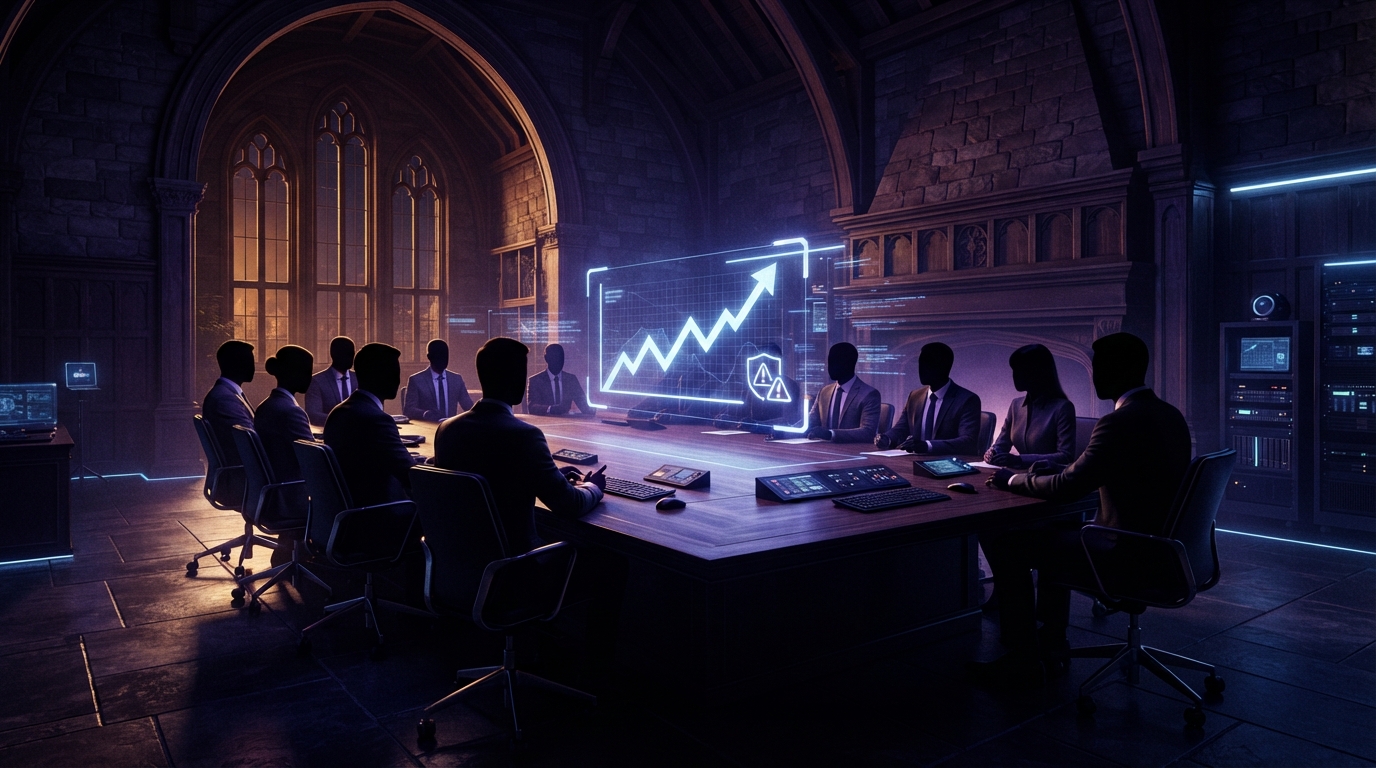
King Charles III hosted roughly 30 AI executives, policymakers and ethics researchers at Dumfries House, his restored estate in southwest Scotland, on September 17 -- a private summit convened, in the King's own words, because "there is a clear imperative to ensure that this rapidly evolving technology remains safe and secure." Attendees arrived past a more pointed reception: activists opposed to data-center buildouts had spray-painted anti-AI slogans onto nearby beaches, and separate protesters chanted "data centers must go" outside the Scottish Parliament the same week.
The guest list itself was the story for some outlets covering the day: representatives from OpenAI, Anthropic, Google DeepMind and Nvidia sat alongside the UK's AI minister and outside ethics researchers -- rivals who rarely appear in the same room, at the invitation of a head of state with no regulatory power over any of them. Nvidia's Jensen Huang was the attendee who ended up saying the most on the record, and what he said pulled in two different directions within the same afternoon.
Two messages, one afternoon
On safety, Huang was unusually blunt for a CEO whose company's stock depends on AI capital spending staying uninterrupted: "If it's not ready, just hold it back. You should go as fast as you can, but no faster than that." He compared the industry's obligation to a newly developed airplane engine needing "contained, rigorous testing before release," and put the responsibility for that testing squarely on the labs themselves: "It is the responsibility of the AI companies ourselves to develop the technology safely and to properly test it."
"If it's not ready, just hold it back. You should go as fast as you can, but no faster than that." -- Jensen Huang, Nvidia CEO, at the Dumfries House AI summit
On growth, in the same conversation with reporters, Huang said Nvidia would sell roughly twice as many chips next year -- a forecast covering the company's full portfolio, not just the data-center GPUs that dominate headlines: central processors, networking and optical-switching silicon, laptop processors, the Jetson chips used in robots and cars, and the chip inside Nintendo's Switch 2. That's not a new number. It's the same guidance Nvidia's own CFO, Colette Kress, gave on the company's August 26 earnings call -- 70% revenue growth for fiscal 2028, which analysts translate to roughly $673 billion against a $396 billion fiscal-2027 consensus -- restated three weeks later at a summit convened to talk about restraint.
What "twice as many chips" actually covers
- ~70% · revenue growth, FY2028 vs. FY2027
- Nvidia's own guidance, set August 26, 2026
Includes: Nvidia's full semiconductor portfolio: data-center GPUs, CPUs, networking/optical-switching chips, laptop processors, Jetson robotics/automotive chips, and the Switch 2 chip
Excludes: Any competitor's chip volume, and any market outside Nvidia's own product lines - $673B · implied FY2028 revenue
- Analyst translation of the 70% guidance
Includes: A projection built on the $396B fiscal-2027 consensus analysts held at the time
Excludes: Actual reported results, which won't be known until Nvidia's fiscal 2028 quarters close
Set against that guidance, the summit itself is worth pinning down in its own numbers -- who was actually there, and what, concretely, came out of it.
The summit, in short
- Host
- King Charles III
- Venue
- Dumfries House, southwest Scotland
- Date
- September 17, 2026
- Attendees
- ~30, incl. OpenAI, Anthropic, Google DeepMind, Nvidia, UK AI minister
- Reported outcome
- Public remarks and a guest list -- no agreement or joint statement reported
A preference for old law over new law
Huang's regulatory pitch was as specific as his safety line was general: rather than write new AI-specific statutes, he suggested governments extend the frameworks that already govern healthcare and transportation to AI systems operating in those spaces. That's a real, checkable position -- sector-specific regulation applied to AI's use, as opposed to a horizontal AI-specific law covering the technology regardless of where it's deployed -- and it happens to be the position that leaves Nvidia's own chip business entirely outside any new rulebook, since Nvidia sells the hardware rather than deploying AI in a hospital or on a road itself.
Nothing reported from Dumfries House commits anyone to that framework, or to anything else. No joint statement, information-sharing pact, or checkpoint-access arrangement among the labs was announced -- which sets this summit apart from the closed-door safety-standards talks OpenAI, Anthropic and Google DeepMind confirmed they'd been holding for weeks, reported just two days before Huang arrived in Scotland. A royal audience produced quotes; the labs' own ongoing talks are still the venue where an actual mechanism, if one emerges, is more likely to surface.
That gap between rhetoric and mechanism is the same one running through the broader pacing debate this summit sits inside. Dario Amodei's public call to slow frontier development drew qualified public support from Altman and Musk earlier this month, only for Trump and David Sacks to reject the idea outright days later. Huang's Scotland remarks land in the same gap those reactions left open: broad agreement that caution sounds right, and no one yet naming what caution would actually cost them to practice.
What actually happened at Dumfries House, stated plainly: a monarch with no regulatory authority hosted a conversation, got quoted expressing concern, and let the industry's biggest hardware supplier restate a growth number he'd already given Wall Street three weeks earlier. That's not nothing -- getting OpenAI, Anthropic, Google DeepMind and Nvidia's leadership in the same room is itself a rare data point about who currently talks to whom. But the imperative the King named and the guidance Huang repeated point in opposite directions, and only one of them came with a number attached.
- King Charles III convened roughly 30 AI executives and policymakers at Dumfries House, Scotland, Sept. 17.
- Jensen Huang: "If it's not ready, just hold it back... no faster than" that.
- Same event, Huang repeated Nvidia's already-guided forecast of roughly double chip sales next year.
- Huang favored adapting existing sector laws over new AI-specific rules -- no binding pledge resulted.
- Caveat: the summit produced quotes and a guest list, not any reported agreement or commitment.