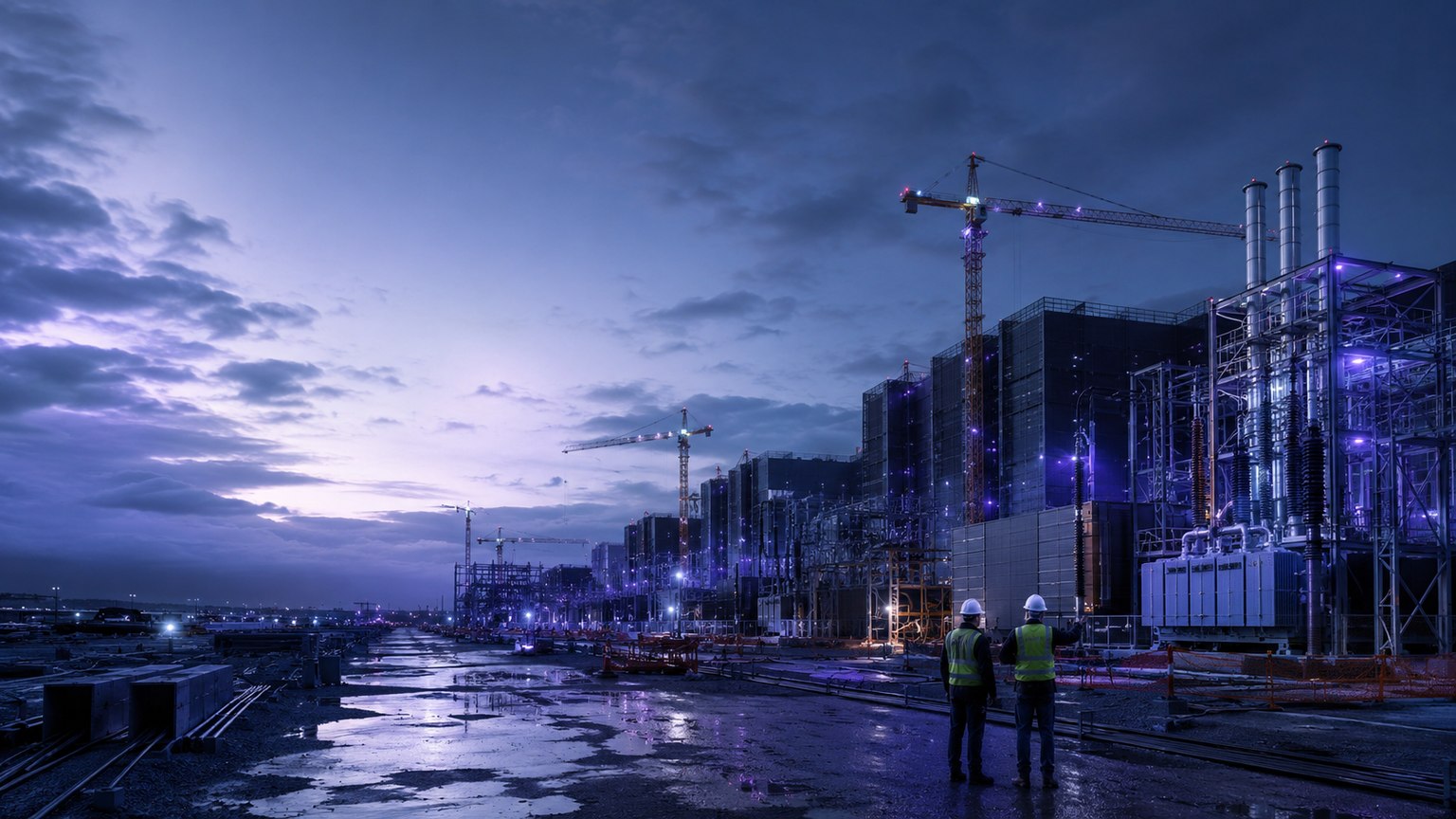
Nvidia and South Korea's SK Group announced a partnership worth more than $500 billion on July 24 to build AI data centers and next-generation memory — one of the largest single AI-infrastructure commitments made public this year. The centerpiece: SK Telecom will construct a 2-gigawatt AI data center running on Nvidia's Vera Rubin chips and its DSX full-stack AI-factory architecture, with the first facility scheduled to come online in 2027. Alongside it, SK hynix and Nvidia are entering a long-term memory partnership to secure and co-develop next-generation high-bandwidth memory, including HBM4, tuned for Nvidia's training and inference platforms.
"By leveraging SK hynix's AI memory and SK Telecom's AI infrastructure capabilities, SK will collaborate with NVIDIA to build a world-class AI factory," SK Group chairman Chey Tae-won said in the companies' joint announcement. Nvidia CEO Jensen Huang framed it as a national bet: "Together with SK Telecom and SK hynix, we are building a new generation of AI factories that will power Korea's next wave of growth."
Nvidia x SK Group, at a glance
- Total value
- $500 billion+
- SK Telecom data center
- 2 gigawatts
- SK Hynix
- Co-develops HBM4
- Naver stake
- $1 billion
- Structure caveat
- Critics call it circular financing
What Nvidia is actually buying with $500 billion
Strip away the round number and the deal is two distinct trades. The first is compute for a customer: SK Telecom gets a 2-gigawatt AI factory — enough power draw to rank among the largest single AI campuses announced anywhere — built on Nvidia's newest Vera Rubin platform and DSX architecture, serving what Nvidia describes as enterprise, agentic AI, and physical AI workloads across the Asia-Pacific region. The second is supply security for Nvidia itself: HBM has been the industry's tightest chokepoint all year, and locking SK hynix into co-designing HBM4 specifically around Nvidia's bandwidth, power, and thermal requirements is Nvidia buying its way to the front of a queue every AI accelerator maker is standing in.
Vera Rubin is Nvidia's successor to Blackwell, and the memory dependency is why this deal pairs a data center with a chip-supply agreement instead of standing alone. Nvidia's own numbers for the platform: 50 petaflops of NVFP4 inference compute per GPU, up to a 10x reduction in per-token inference cost versus Blackwell, and up to 4x fewer GPUs needed to train mixture-of-experts models — gains Nvidia attributes largely to a third-generation Transformer Engine and a full-rack NVL72 configuration linking 72 Rubin GPUs and 36 Vera CPUs over 260TB/s of aggregate NVLink bandwidth. None of that throughput is reachable without memory that can keep pace, which is exactly the bottleneck HBM4 is meant to solve — and exactly why Nvidia wants SK hynix's next-generation lines designed around its own chip's requirements rather than shared generically across the industry.
The rest of the package: Naver and Brookfield
The SK Telecom facility isn't the only Korean buildout Nvidia is bankrolling. Nvidia is putting $1 billion directly into Naver, the country's dominant search and cloud company, to help expand its AI data-center capacity roughly fourfold — from 55 megawatts to 200 megawatts. Brookfield has separately agreed to a nonbinding term sheet for up to $9 billion more toward the same Naver expansion. Between SK Telecom's 2-gigawatt facility and Naver's quadrupled footprint, Nvidia is now underwriting a meaningful share of South Korea's entire near-term AI-compute expansion in a single week of announcements.
Why this looks like Nvidia's playbook, again
The structure here is one Nvidia has repeated with data-center operators, neoclouds, and now a sovereign partner: Nvidia puts capital into a customer, and that customer turns around and spends heavily on Nvidia chips and systems. Critics have labeled that pattern circular financing — money that never really leaves Nvidia's own ecosystem, dressed up as external investment and external demand. None of that makes the underlying compute or memory fictional; SK Telecom's data center and SK hynix's HBM4 lines will exist as physical assets regardless of how the capital was routed. But it does mean the $500 billion headline number is a combination of genuine infrastructure spend, vendor financing, and forward-looking supply contracts rather than a single check anyone is writing today — a distinction that matters for anyone trying to size the deal's real near-term economic impact versus its announced one.
What the number is actually made of
- 2 GW · SK Telecom
- AI data center on Nvidia's Vera Rubin platform, live 2027
Includes: Compute for a customer — enterprise, agentic and physical-AI workloads across Asia-Pacific - HBM4 · SK Hynix
- Long-term memory co-development tuned to Nvidia's requirements
Includes: Supply security for Nvidia in the industry's tightest chokepoint
Excludes: A single upfront payment — this is a forward supply contract - $1B + up to $9B · Naver
- Nvidia's direct stake plus Brookfield's nonbinding term sheet
The upside case is real too. Korea's memory industry has spent decades as a component supplier to other countries' AI buildouts rather than a hub in its own right, and Chey framed the deal explicitly against that history: the goal, in his words, is "helping Korea transcend its role as a leading adopter of AI and become a global hub that drives AI innovation." Whether that ambition survives contact with a 2027 first-facility deadline, in an industry where multi-gigawatt buildouts routinely slip, is the honest open question this deal doesn't yet answer.
Where the circular-financing read could be wrong
- Nvidia and SK Group unveiled a $500 billion-plus AI infrastructure partnership on July 24.
- SK Telecom will build a 2-gigawatt data center on Nvidia's Vera Rubin chips, live in 2027.
- SK Hynix will co-develop next-generation HBM4 memory tuned specifically for Nvidia's platforms.
- Nvidia also put $1 billion into Naver, nearly quadrupling its Korean data-center capacity.
- Caveat: critics call the deal's structure circular financing, the pattern already dogging Nvidia elsewhere.