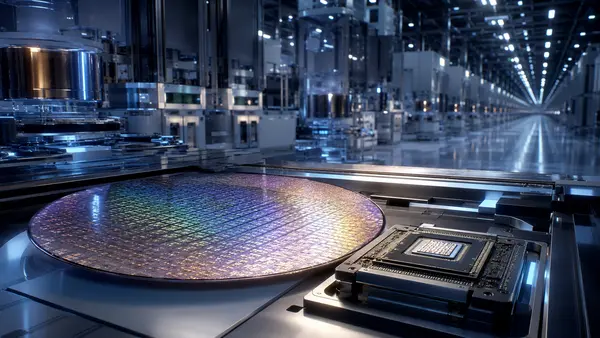
TSMC's delayed June sales update landed Monday with the cleanest demand signal the AI industry has produced this quarter. The world's largest contract chipmaker reported second-quarter revenue of T$1.27 trillion, about $39.62 billion, up 36% from a year earlier and slightly above the LSEG SmartEstimate cited by Reuters. June alone reached T$442.68 billion, up 67.9% year over year and 6.2% from May. The release had been postponed after Typhoon Bavi closed Taiwan's financial markets, but the delay did nothing to soften the number: the factory at the center of the advanced-chip supply chain just posted another record.
A foundry result is a census of demand
TSMC is not a model vendor telling you how many prompts were sent, and it is not a cloud company deciding which revenue to label AI. It manufactures the leading-edge silicon designed by companies across the stack, including major customers in accelerators, phones and custom compute. That makes its sales closer to a physical census of demand. Orders have to become wafers, packaging slots and finished chips before they can appear in this line. When revenue rises this quickly at the bottleneck, the argument that AI infrastructure demand is mostly a narrative becomes much harder to sustain.
TSMC quarterly revenue, 2026
What the number does not prove
Revenue is not the same thing as profit, and a record quarter does not settle the valuation argument around the AI trade. TSMC reports full second-quarter results on Thursday. Analysts surveyed by LSEG expect a sharp increase in net income, but the more important details will be management's view of margins, capital spending and how quickly advanced-node and packaging capacity can expand. A manufacturer can be sold out and still face expensive constraints. The next stage of the story is whether capacity growth preserves economics or merely moves the shortage to another part of the line.
When the factory making the industry's most constrained parts posts a record, the demand debate ends. The capacity debate begins.
The constraint has moved down the stack
The AI buildout is no longer limited by a single GPU order book. It now runs through advanced packaging, high-bandwidth memory, power equipment, cooling systems and grid connections. That is why a TSMC result matters beyond semiconductors: it tells utilities, construction firms and equipment suppliers that the upstream customer is still pulling. It also tells hyperscalers that every model roadmap carries a physical delivery schedule. Software can be copied in seconds. A fabrication plant, transformer or packaging line cannot.
Three things to watch Thursday
First, gross margin: it shows whether record demand is translating into durable pricing power after the cost of new fabs and overseas expansion. Second, capital expenditure: another increase would confirm that TSMC believes the order book extends well beyond one launch cycle. Third, capacity commentary around the most advanced process nodes and packaging. If management says those queues remain tight into 2027, the industry's near-term ceiling will still be set by manufacturing throughput rather than model ambition.
The useful conclusion is narrower than 'AI wins forever' and stronger than 'the boom is hype.' The physical supply chain is recording real, accelerating revenue. The burden of proof now shifts to the companies buying all of that compute: they still have to turn it into products, cash flow and productivity before the infrastructure bill becomes a return.
- TSMC's Q2 revenue hit a record T$1.27 trillion (~$39.6B), up 36% year over year.
- A foundry record is a physical census of AI demand — orders became actual wafers.
- The constraint moved down the stack: packaging, memory, power and grid connections.
- Thursday's full results: watch gross margin, capex and advanced-node capacity commentary.
- Caveat: revenue isn't profit, and record demand doesn't settle the valuation argument.