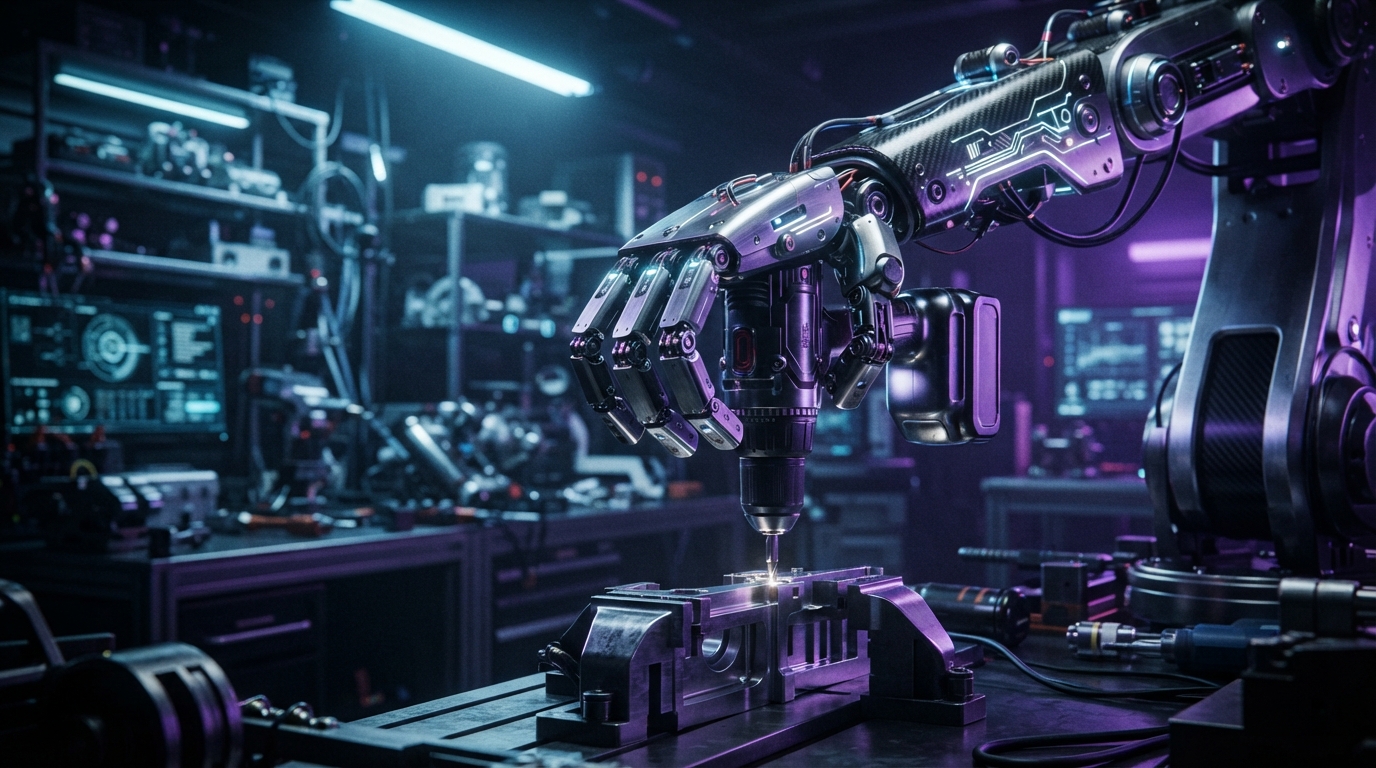
Boston Dynamics released video Oct. 1 of a redesigned hand for its Atlas humanoid robot -- and the headline change is what it took away. The new hand has 3 fingers plus a thumb -- 4 digits in total, down from 5 -- losing the pinky entirely, while roughly doubling the hand's degrees of freedom to 13, up from seven in the previous version. "Hands are a ruthless design trade-off," said Alberto Rodriguez, Boston Dynamics' director of robot behavior. "There's no way around it, you're always giving up on something."
The decision to cut the pinky reportedly came out of a low-tech experiment before any CAD work: engineers taped their own pinkies to their ring fingers for a day and found the missing digit never actually blocked a task they cared about. What survived the cut is a deliberately different actuation approach from most of the field -- direct-drive motors built into each joint, large enough to be back-driven and sense force through contact itself rather than through tendons or cables. Boston Dynamics says that trade-off buys easier simulation, cheaper field repair (each actuator pack is a single replaceable unit), and a design meant for mass production, with a stated goal of 100,000 hands a year -- a target, not a current output.
The design logic ties back to how Boston Dynamics says it wants to teach Atlas new skills. A hand shaped close enough to a human's, in proportion and reach, lets the company reuse human demonstrations to train the robot through reinforcement learning in simulation rather than hand-coding each motion. Fewer motors and no tendons also make the hand easier to model faithfully inside a physics simulator in the first place -- a cleaner simulation means a more reliable policy once it ships to real hardware, the company argues, which is a different value proposition than raw manipulation range.
That bet looks unusual next to where the rest of the humanoid-hand field has been heading. Tesla's Optimus hand, revealed in its current tendon-driven form in late 2024 and still the basis for its production design, runs 22 degrees of freedom in the hand alone -- 25 counting the wrist -- with actuators relocated to the forearm to "mimic human tendons," in engineering lead Milan Kovac's phrase. 1X Technologies went further still with its NEO hand, unveiled in July 2026: also 25 degrees of freedom, also tendon-driven, with high-resolution fingertip sensors the company says detect slip and adjust grip in real time. Both companies kept all five fingers. Both are chasing more motion, not less.
Three humanoid hands, three different bets
| Boston Dynamics Atlas revealed Oct. 1, 2026 | 1X NEO revealed Jul. 2026 | Tesla Optimus hand revealed late 2024 | |
|---|---|---|---|
| Digits | 4 (no pinky) | 5 | 5 |
| Degrees of freedom | 13 | 25 (22 hand + 3 wrist) | 25 (22 hand + 3 wrist) |
| Actuation | Direct-drive, no tendons | Tendon-driven, quasi-direct-drive | Tendon-driven, actuators in forearm |
| Stated annual manufacturing capacity | 100,000 (goal, not current output) | 10,000 (several hundred units produced so far) | Not disclosed |
The actual disagreement isn't about dexterity in a demo clip -- it's about what breaks first at scale. More independently actuated joints means more motors, more wiring, and more individual points of failure inside a hand that a robot is going to bang into things for a living; Boston Dynamics' bet is that fewer, larger, back-drivable actuators are cheaper to build, simpler to simulate, and easier to fix in the field once a company is shipping tens of thousands of units a year rather than hundreds. 1X says it has already produced several hundred NEO units toward a stated annual capacity of 10,000; Boston Dynamics hasn't disclosed current Atlas hand production at all, only the 100,000-unit aspiration.
None of that trade-off is testable from the outside yet. In the released footage, Atlas's new hand picks up a slender drill bit, seats it in a power drill, tightens a nut, and separately rotates two golf balls freely within one palm -- a classic in-hand-manipulation benchmark. It's genuinely impressive footage. It is also, like Tesla's tennis-ball-catch demo and 1X's own reel, curated rather than independently measured -- none of the three companies has published a shared benchmark a reader could use to compare them directly.
“Hands are a ruthless design trade-off. There's no way around it, you're always giving up on something.” — Alberto Rodriguez, Boston Dynamics' director of robot behavior
The redesign also isn't landing in a vacuum -- Atlas already has a real deployment to answer to. Boston Dynamics' entire 2026 production run is reportedly committed to just two customers: parent company Hyundai Motor Group and research partner Google DeepMind. Hyundai opened a dedicated Robotics Metaplant Application Center at its Georgia manufacturing campus this year to train Atlas units on parts logistics and assembly sequencing, with plans to deploy 25,000 Atlas robots across Hyundai and Kia plants globally over the next several years. A hand that's cheap to repair and easy to simulate matters a great deal more at that scale than it does in a single viral demo -- which is the context Boston Dynamics' manufacturing argument is actually aimed at.
The release lands a day after Figure AI retired its entire first-generation humanoid fleet by melting it down in a Finnish steel foundry rather than let the hardware's design details leak -- a reminder that on this beat, a single hand or a whole robot generation can go from flagship reveal to scrapped within two years. Whichever actuation bet turns out to be right, the company still iterating in public two generations from now is the one that will have actually answered the question.
- Boston Dynamics unveiled a redesigned Atlas hand Oct. 1 with four digits instead of five.
- The new hand has 13 degrees of freedom, built on direct-drive motors rather than tendons.
- Tesla's and 1X's rival hands both use tendons and roughly double the degrees of freedom.
- Fewer motors may mean fewer failure points at scale -- a claim none of the three has proven.
- Caveat: all three companies' demos are curated footage, not an independently measured benchmark.