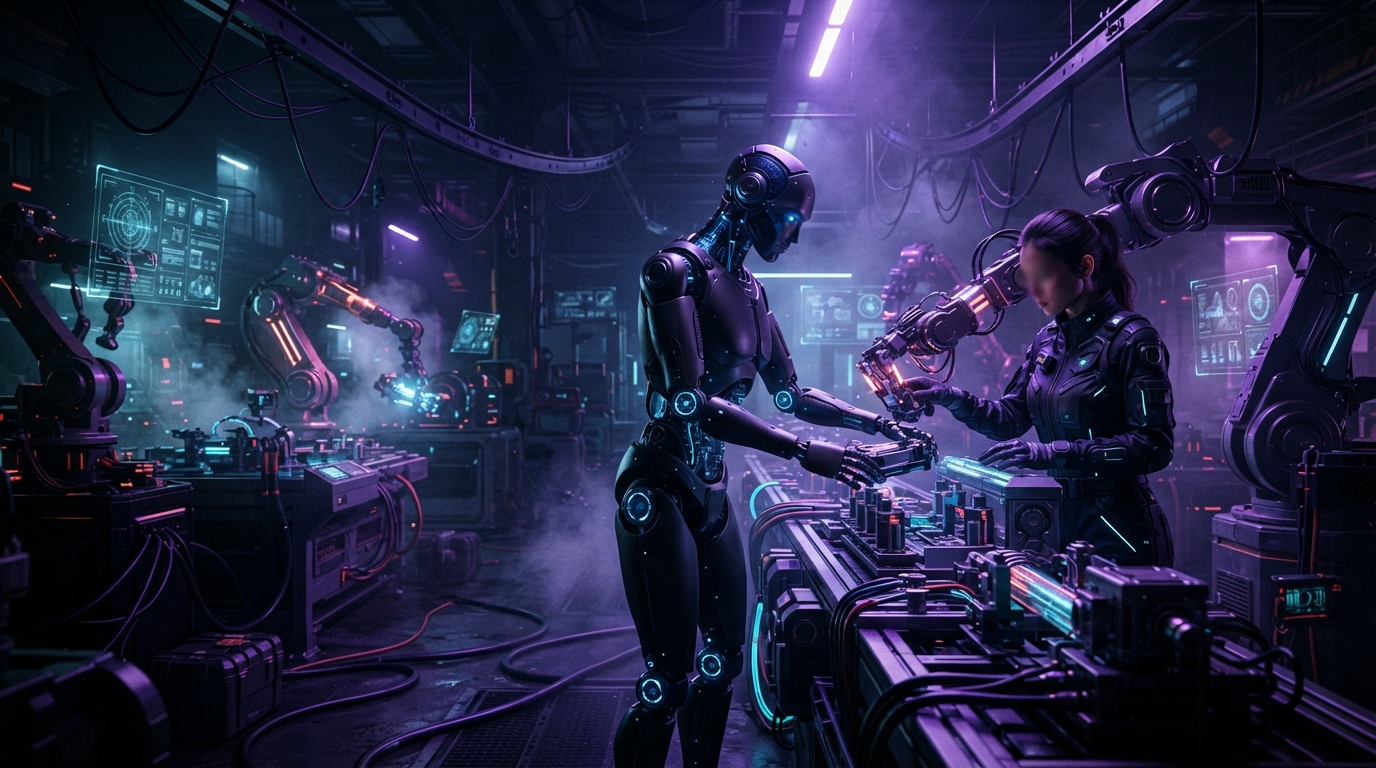
Korea's Ministry of Trade, Industry and Energy announced on Oct. 13 that its Industrial Convergence Regulatory Sandbox Review Committee -- the sixth such meeting this year -- had granted Robros, a domestic bipedal-humanoid maker, an exemption to deploy 20 of its robots on live factory floors. The sites are specific and varied: Nepes, where the robots will remove contaminants from circular components used in semiconductor back-end packaging; Sungwoo Hitech, placing auto body parts in designated positions; HD Hyundai Samho, stacking scaffolding brackets during shipbuilding; and Delivery Lab, moving refrigerated logistics packaging. In every case, the robots will work in space shared with, or adjacent to, human employees.
That last detail is the whole reason this needed a sandbox exemption at all. Korea's existing industrial-robot safety standards assume a stationary machine, caged behind fences that separate it from anyone walking the floor -- a design built for a robot arm bolted to one spot, not a machine that walks, turns, and reaches for the same shelf a person is reaching for. A humanoid that moves through a shared workspace doesn't fit that rulebook, so until this exemption, every humanoid deployment in Korea needed its own one-off sandbox approval, company by company. Trade Minister Kim Jung-kwan put the gap plainly: "AI technology is advancing so fast that regulation struggles to keep up."
The exemption, in short
- Who
- Robros
- What
- 20 robots, live factory deployment
- Where
- Nepes, Sungwoo Hitech, HD Hyundai Samho, Delivery Lab
- What it isn't
- Not a safety certification
Robros itself is a small company making a large leap. CEO Noh Seung-joon told reporters the company has sold 18 of its Egris-C humanoids to date and plans to pass 50 cumulative units by year-end -- numbers that put this factory-floor test well ahead of the company's own production scale, not behind it. Noh's bet is specifically sequenced: "The humanoid revolution will happen first in manufacturing and logistics," he said, with services and home use following only once price competitiveness and accumulated data catch up. The company's current flagship proof point is a pilot with Lotte Global Logistics, where Noh says the robot now handles target tasks "with minimal human intervention" -- a claim that comes from the company running the pilot, not from an outside measurement of it.
For scale, the same report that announced the sandbox exemption points to a bigger deployment already running abroad: BMW's Spartanburg, South Carolina plant has had Figure AI's Figure 02 humanoid handling over 90,000 parts across roughly 10 months, according to that report's own comparison. Twenty robots at four Korean sites, drawn from a company that has sold 18 units total, is a much earlier moment on the same curve -- not a competing claim to it.
Two humanoid factory deployments, at very different scales
| Robros (Egris-C) Korea sandbox, 2026 | Figure AI (Figure 02) BMW Spartanburg, per Korean press report | |
|---|---|---|
| Units in this deployment | 20 | Not disclosed in this report |
| Track record cited | 18 units sold company-wide to date | Over 90,000 parts handled across roughly 10 months, per the same report |
| Regulatory status | Temporary sandbox exemption, safety rules not yet rewritten | Not addressed in this report |
| Task type | Contaminant removal, part placement, bracket stacking, package handling | Parts handling on an auto assembly line |
The install-base numbers behind this push are stark, and the ministry cited them directly: Korea installed 30,200 industrial robots in the latest year the International Federation of Robotics tracked, against 354,200 in China, 38,400 in the US and 36,200 in Japan. The Korea Institute for Industrial Economics and Trade scores the country's manufacturing-robot competitiveness at 72.9, behind the US's 80.6 and China's 79.4. None of those figures are humanoid-specific -- they count the stationary robot arms that have dominated factories for decades -- which is exactly why a government that is losing the current robotics race has an incentive to move early on the next one.
Why Korea is moving -- scoped to what the numbers actually count
- 30,200 · robots installed, latest year
- Korea's industrial-robot installations.
Includes: All industrial robots, overwhelmingly stationary arms -- not a humanoid-specific count.
Excludes: Any breakdown by robot type; humanoids are a rounding error inside this figure today. - 354,200 / 38,400 / 36,200 · China / US / Japan
- The same measure for Korea's three largest competitors.
Includes: Same International Federation of Robotics basis as the Korea figure, for comparability.
Excludes: Nothing about which installs are humanoid versus traditional. - 72.9 vs. 80.6 (US) / 79.4 (China) · KIET competitiveness score
- Korea Institute for Industrial Economics and Trade's score for manufacturing-robot competitiveness.
Includes: The institute's own composite methodology.
Excludes: What specific inputs make up the score -- not published in the cited report.
The government's own framing of the test is narrower than the headline suggests, and worth taking at face value rather than reading past it: this is a data-collection exercise, not a safety verdict. Hanyang University robotics engineering professor Han Jae-kwon put the purpose in research terms: "What matters is expanding the tests and accumulating behavioral data, such as how skilled workers move." That data is meant to feed a rewrite of the safety standard itself -- turning the fence-based rule into one that can actually describe a machine working in the open, rather than certifying today's Egris-C as safe under a standard that doesn't fit it.
- Robros's Egris-C handles its target logistics tasks with minimal human intervention.
- Robros will have more than 50 Egris-C units in cumulative production by the end of 2026.
The gap between the two Egris-C numbers -- 18 sold, 20 about to run a live factory floor -- isn't a typo, and it's the most useful fact in this story if you're trying to judge how far along humanoid robotics actually is anywhere, not just in Korea. A company doesn't need thousands of units in the field to get a government to rewrite safety law around it; it needs a government that has already decided the rewrite is coming and is looking for a willing, well-documented first mover. Noh's own account of Robros's history supports that reading: the company started as a novelty, a "robot cafe," and pivoted toward manufacturing only once factory owners, not consumers, showed up asking for it. The hardware still has real gaps even by the CEO's own account -- heat resistance and dust- and waterproofing for shipyard and chip-fab conditions are listed as needed upgrades, not finished ones.
Korea's government has reasons of its own to move fast here that have nothing to do with how ready any particular robot is. The ministry's own framing cites labor shortages and a push toward AI-driven manufacturing transformation as the motivation -- language that reads differently once set against the install-base numbers above: a country whose robot-manufacturing competitiveness already trails its two biggest regional rivals has an incentive to win the *next* category outright rather than keep chasing the current one. A sandbox exemption that produces usable safety data, even from just 20 robots at four sites, is cheap compared to the alternative of watching China's existing volume lead widen in the categories that already exist. That's a coherent industrial-policy bet. It is a different thing from evidence that Egris-C is ready for an unfenced factory floor at scale -- and the ministry's own statement of purpose doesn't claim otherwise.
- Korea's trade ministry granted Robros a sandbox exemption for 20 factory humanoids Oct. 13.
- Current robot safety rules require fences; these humanoids share open floor space with workers.
- Robros has sold only 18 units total -- the test gathers data, it doesn't certify safety.
- Sites include a chip-packaging plant, an auto-parts maker, a shipyard and a warehouse.
- Korea trails China, the US and Japan on industrial-robot installs and robotics competitiveness scores.