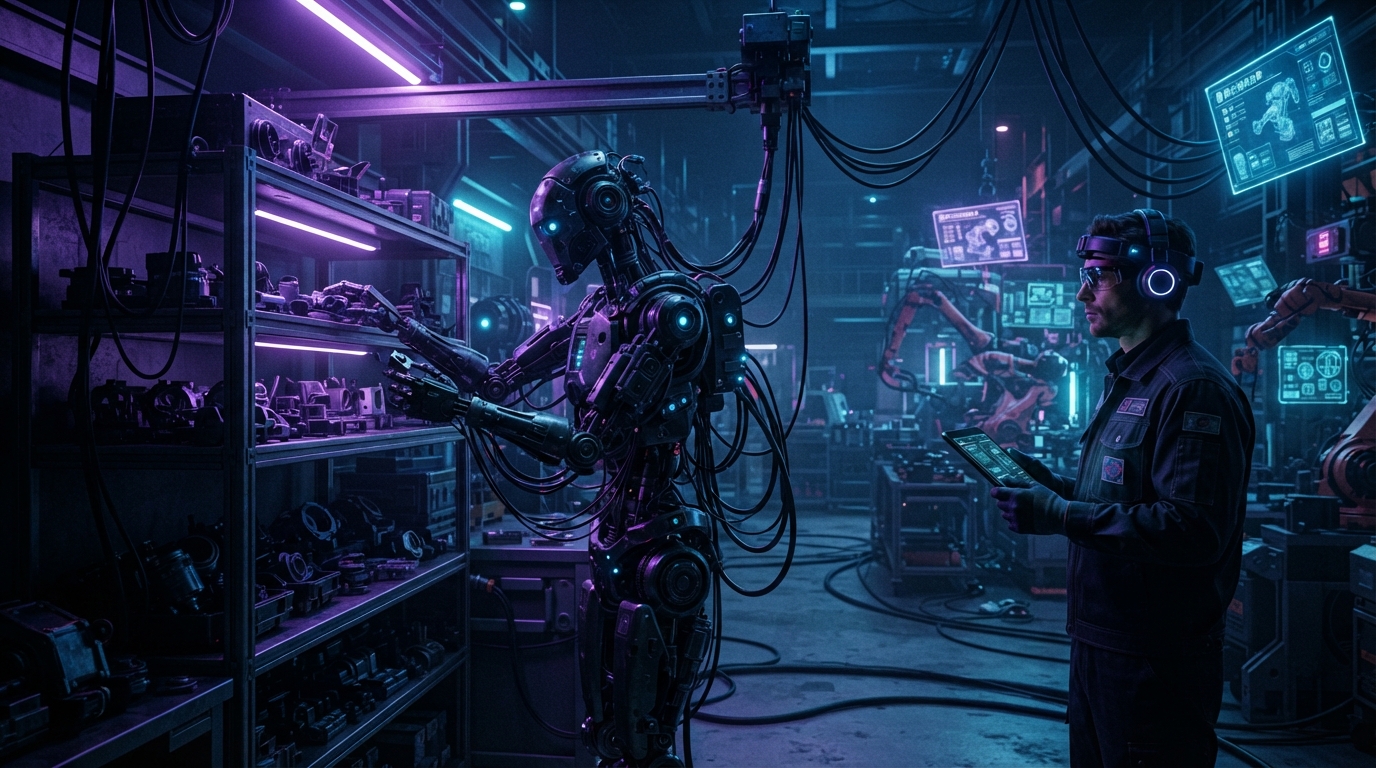
Most humanoid-robot demos run a few polished minutes. Nucleus, a startup deploying humanoid labor at a German manufacturer, released a nearly 2-hour, unedited video on Oct. 1 instead -- parts picking, shelf loading, cart transport, shot straight through with every hesitation, error and human intervention left in. The company's own number for that footage: 60% autonomous, 40% teleoperated. Founder and CEO Melvin Schwarz called it, in a post on X, "a major breakthrough in humanoid labor and physical intelligence." Nucleus did not publish how the percentage was calculated, what counted as a teleoperated action versus a brief corrective nudge, or whether the ratio holds across a full shift rather than just the two hours chosen for release.
The company deployed the robot at the manufacturer in under 90 days under human supervision, and says it now runs 4-to-6-hour shifts with the robot completing jobs start to finish -- extended operation, not just a single showcase clip. Nucleus has not framed teleoperation as a stopgap it is racing to eliminate; instead, the company presents human assistance as a deliberate data-collection mechanism feeding its own autonomy improvements, a positioning that is itself a bet about what builds investor and customer trust faster: a bigger claimed number, or a smaller, disclosed one.
The footage itself is the unusual part. Most humanoid demo reels released this year cut around the failures -- a 50-hour sorting run, a flawless warehouse walkthrough, a single clean take of a robot folding laundry. Nucleus instead left in the pauses where the robot appeared to wait on a human cue, the moments a part was repositioned by hand, and stretches where the pace visibly slowed before picking back up. None of that is independently timestamped or broken out task-by-task in a way that would let an outside viewer check Nucleus's own 60% figure against the video frame by frame -- the company is asking to be trusted on the math, even while showing more of the raw process than any competitor has chosen to.
What the company showed, and claimed
- Footage
- ~2 hours, uncut, including hesitations and human interventions
- Self-reported split
- 60% autonomous / 40% teleoperated
- Tasks shown
- Parts picking, shelf loading, cart transport
- Deployment site
- A German manufacturer, under 90 days to deploy
- Claimed shift length
- 4-6 hours, job completed start to finish
That number lands in the middle of an industry argument that predates this particular video. Figure CEO Brett Adcock has spent months publicly rejecting teleoperation outright: "There's absolutely no teleoperation into this," he said of a May livestream in which Figure's robots reportedly sorted packages for roughly 50 hours nonstop. Adcock has since escalated, dismissing rivals' teleoperated demonstrations as "soy stuff" and stating flatly, "we will not teleoperate them in market." His sharpest framing: that public demos relying on a human-in-the-loop pilot are "perhaps some of the most deceiving things I've ever seen."
Two humanoid companies, two disclosure strategies
| Nucleus | Figure | |
|---|---|---|
| Public autonomy claim | 60% autonomous (this demo) | 0% teleoperation, claimed across operations |
| Methodology published | No | No |
| Independently verified | No | No |
| Stance on teleoperation | Disclosed and framed as a data-collection step toward autonomy | Rejected outright; calls disclosed teleoperated demos deceptive |
Put side by side, the two companies are making opposite bets about what the market rewards. Nucleus is betting a smaller, disclosed number builds more durable trust than a bigger one nobody can check. Adcock is betting that the bigger number, stated flatly and defended aggressively, is worth more than the credibility a disclosed ratio might buy -- and that framing any visible human assistance as disqualifying keeps the pressure on rivals to either match his claim or look behind.
What neither company disputes is that no outside party has measured either number. Nucleus's 60/40 figure is the company's own, reported without a stated method for distinguishing "autonomous" motion from a pilot's brief correction. Figure's zero-teleoperation claim rests on the same foundation: Adcock's word, backed by a livestream his own company produced and narrated. The field has no agreed instrument for telling the two kinds of claim apart, which means the real story is not which number is bigger, but that an entire industry is currently asking investors, customers and the public to take its most basic performance metric on faith.
(A reasonable outside observer has no way, today, to tell a well-disclosed 60% from a well-marketed 0% without either an independent audit or raw sensor logs neither company has released.) Until an independent benchmark exists -- something Artificial Analysis-style aggregators have done for language models but nobody has built for physical autonomy -- the honest reading of both claims is the same: company-reported, unverified, and worth exactly as much as the viewer's trust in the company saying it.
For a buyer actually weighing a humanoid deployment, that gap matters more than either company's marketing. A manufacturer evaluating Nucleus is buying a disclosed 40% labor cost it can plan a staffing line around today, with a stated path to shrinking it. A manufacturer taking Figure's claim at face value is buying a number nobody outside Figure can check, which is either a genuinely more capable robot or a demo that has not yet met a skeptical third party -- and from the outside, those two possibilities currently look identical. The real demo-versus-shipping gap in humanoid robotics right now isn't between flashy claims and modest reality; it's between one company's claim backed by its own supporting video, and another company's claim backed by nothing a buyer can independently check at all.
- Nucleus's humanoid robot ran at a 60% autonomous / 40% teleoperated split during the released factory footage.
- Figure's humanoid robots operate with zero teleoperation.
- Nucleus released nearly two hours of uncut factory footage of its humanoid robot, including hesitations and human interventions left visible.
- The company says the demo was 60% autonomous and 40% teleoperated -- its own figure, with no disclosed method for how it was calculated.
- Nucleus deployed the robot at a German manufacturer in under 90 days and says it now runs 4-6 hour shifts.
- Figure CEO Brett Adcock, who says his robots use zero teleoperation, calls disclosed teleoperated demos "perhaps some of the most deceiving things I've ever seen."
- Caveat: neither company's autonomy figure is independently verified -- both are self-reported, and the industry has no agreed way to measure the difference.