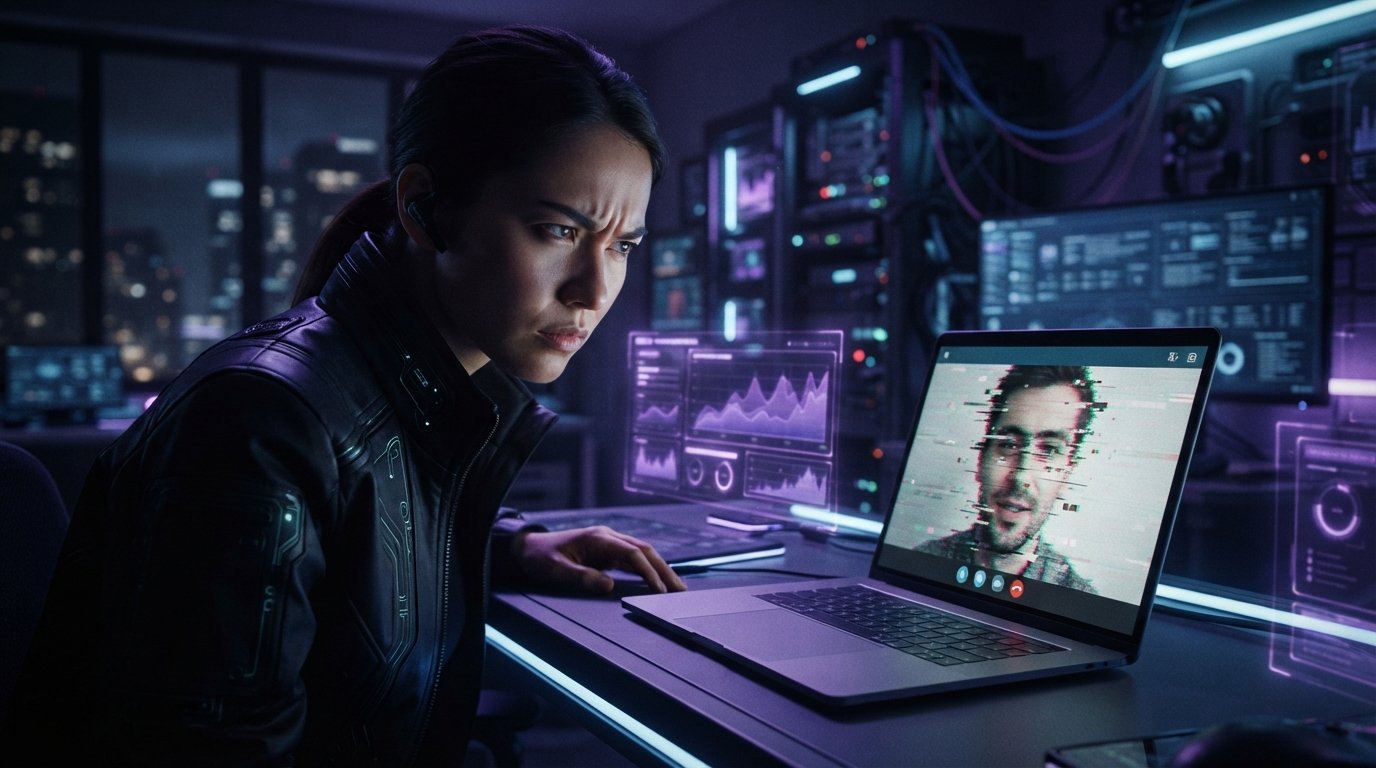
The fastest way to catch a real-time deepfake on a video call is to ask the person to do something a scammer's software still struggles to fake live: turn their head to the side, wave a hand in front of their face, or share their actual screen. None of that requires special software of your own -- just a habit of actually testing a call instead of trusting it because the face and voice look right.
The FBI's Internet Crime Complaint Center updated its fraud-recovery warning on July 20, 2026, and the update itself is the news: criminals are no longer only impersonating voices by phone. The bulletin, which updates an April 2025 advisory, describes scammers using deepfake video of real, senior FBI officials to redirect fraud victims to a spoofed version of the IC3 reporting site -- a second con layered on top of the first. The same bulletin's advice for spotting the fake applies just as well to an ordinary video call: watch for distorted hands and facial features, inaccurate shadows, unrealistic accessories, and unnatural lag or cadence.
The tests a live deepfake usually fails
Security researchers at Kaspersky and elsewhere have converged on the same short list of checks, because they target the same weakness: current real-time deepfake tools are still better at mimicking a face at rest than a face asked to do something specific and unscripted.
Test a video call you're not sure about
- Most real-time deepfakes are built from portrait footage; a full profile view is where the face is most likely to float, blur, or break apart.
- Have them wave a hand in front of their face, scratch their nose, or drink from a cup. Hands remain one of the hardest things for real-time face-swap tools to render correctly.
- A live screen share of an actual file, inbox, or desktop is far harder to fake than a face, since it requires controlling the real person's actual device.
- A recent shared detail works, but a codeword you and the real person agreed on in advance, through a separate channel, is stronger -- it was never public for a model to learn.
- Never use a number or link the call itself gave you -- get it from your own contacts, a prior bill, or the organization's official site.
Running those five checks closes most of the gap. The ways people skip them anyway cluster around a few recurring mistakes.
Three ways this check gets skipped when it shouldn't be
None of this requires installing anything or becoming a deepfake-detection expert. The five tests above work because they ask the call to do something specific and unscripted -- which is exactly the part current real-time deepfake tools still handle worst. Verifying whether a pre-recorded video is AI-generated is a related but different problem; a live call gives you one advantage a recording never will: the chance to ask it to prove itself.
- The FBI's July 2026 bulletin confirms scammers now use deepfake video of real officials, not just cloned voices.
- Ask the caller to turn sideways or wave a hand -- real-time deepfakes often distort at these moments.
- Lip-sync lag, frozen smiles, and mismatched lighting are visual tells deepfake software can't fully fix.
- A pre-agreed codeword defeats a deepfake instantly -- the software has no way to know it.
- If anything feels urgent or pressured, hang up and call back on a number you already have.