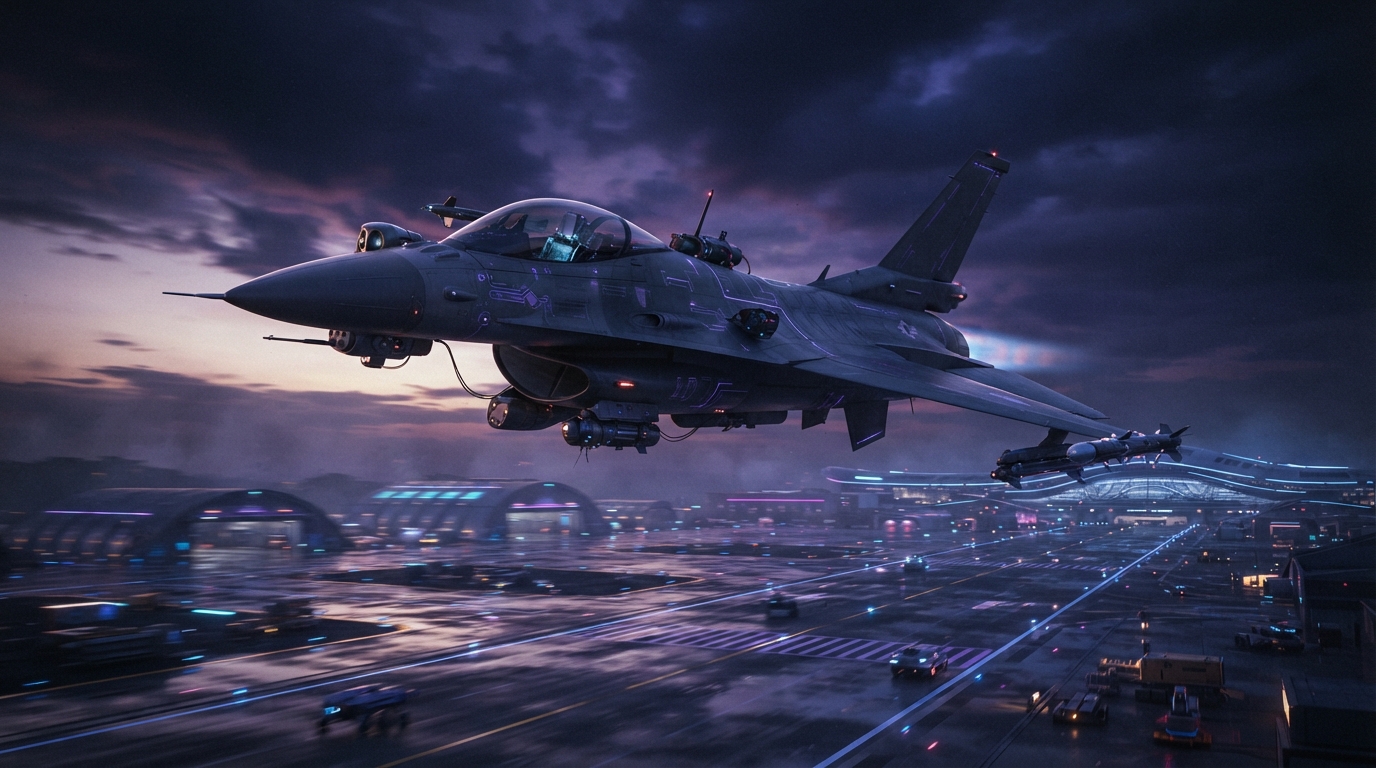
A US Air Force F-16 flew under the control of an AI agent for the first time in July, with a human safety pilot in the cockpit the whole time. DARPA and the Air Force disclosed the test on July 16, describing it as the first time a standard operational fighter jet — not a dedicated one-off testbed — has flown under artificial-intelligence control at Eglin Air Force Base in Florida.
The aircraft belongs to the Viper Experimentation and Next-generation Operations Model program, or VENOM — a joint DARPA and Air Force effort that converts existing F-16s into autonomy-capable aircraft rather than building purpose-designed drones. VENOM sits under DARPA's longer-running Air Combat Evolution (ACE) program, which has spent several years teaching AI agents to fly and fight.
VENOM, in short
- Program
- VENOM
- Parent program
- ACE
- Aircraft
- Standard F-16s
- Location
- Eglin Air Force Base, FL
- First AI-controlled flight disclosed
- July 16, 2026
How the human-AI handoff actually works
The conversion runs through what DARPA calls the VENOM Autonomy Kit, additional flight-control hardware and sensors bolted onto a standard airframe. DARPA's own description of the work is specific on one point: "The Air Force and DARPA team has automated flight controls and sensors on a standard F-16 without changing the jet's core software." The autonomy layer sits alongside the F-16's existing systems rather than replacing them.
Testing proceeded in stages. The service began flying VENOM-modified aircraft in June 2026 to confirm the modified jets and their new systems operated safely with a human pilot flying normally. Only in July did test teams let the AI agent actually fly, with the safety pilot able to transfer control between the cockpit and the AI agent through a dedicated switch — and to take it back the same way, at any point, if something looked wrong.
- Flies takeoff and initial setup normally
- Engages the VENOM Autonomy Kit switch, handing flight control to the AI agent
- Flies the aircraft; safety pilot monitors from the cockpit
- Can reclaim control at the same switch at any time
This isn't the first AI-flown fighter — VENOM is a different kind of step
DARPA has demonstrated AI-controlled fighter flight before. The X-62A VISTA, a specially instrumented one-of-a-kind test aircraft, flew autonomously under the ACE program starting in 2022 and was later used to demonstrate an AI agent flying within visual range of another aircraft — a basic dogfighting maneuver — with a safety pilot aboard. That work proved the concept was possible. What it didn't prove is that the concept scales past a single, extensively modified research jet that the Air Force built specifically for this purpose.
X-62A VISTA vs. the VENOM fleet
| X-62A VISTA ACE program, since 2022 | VENOM F-16s current program | |
|---|---|---|
| Aircraft type | One-of-a-kind research jet | Standard operational F-16 airframes |
| Autonomy hardware | Deeply integrated, purpose-built test systems | Add-on VENOM Autonomy Kit, no core software change |
| What it proved | AI can fly a fighter and perform basic air-to-air maneuvers | A production aircraft type can be converted, not just a bespoke testbed |
| Fleet path | Not a production path — a single research airframe | Feeds DARPA's multi-aircraft AIR program |
What comes next, and what's still unverified
DARPA says the VENOM aircraft will next support the Artificial Intelligence Reinforcements (AIR) program, which is aimed at multi-ship autonomous combat — more than one AI-flown aircraft operating together, rather than a single jet flying solo. Brig. Gen. James Valpiani, the outgoing DARPA program manager on ACE, is handing the AIR portfolio to Lt. Col. Patrick Highland, with Terry Wilson of the Air Force Research Laboratory's Autonomy Capability Team continuing as deputy program manager — continuity DARPA is presenting as evidence the program is moving from demonstration toward a sustained effort rather than a one-off test.
What DARPA has not published is a flight count, total flight hours, or a granular account of what the AI agent actually did at the controls beyond basic flight — turns, altitude changes, standard maneuvers are implied but not itemized in the public disclosure. Every fact in this story traces to DARPA's own announcement and outlets that DARPA briefed directly; no independent flight-test authority or foreign government has verified the claims, and DARPA is, by design, describing a defense program on its own terms.
That matters for how to read the milestone. "An AI flew an F-16" is accurate. "An AI is ready to fly combat missions" is not a claim DARPA has made — a human pilot has been in the cockpit, hand on the switch, for every flight disclosed so far.
- DARPA and the Air Force disclosed July 16, 2026 that a VENOM-modified F-16 flew under AI control.
- VENOM converts standard F-16s, not a one-of-a-kind testbed like the earlier X-62A VISTA jet.
- A safety pilot stays aboard every flight and can reclaim control with a dedicated switch.
- The VENOM kit adds sensors and flight-control hardware without changing the F-16's core software, DARPA says.
- DARPA hasn't disclosed flight counts or durations — the claim is verifiable only as DARPA describes it.