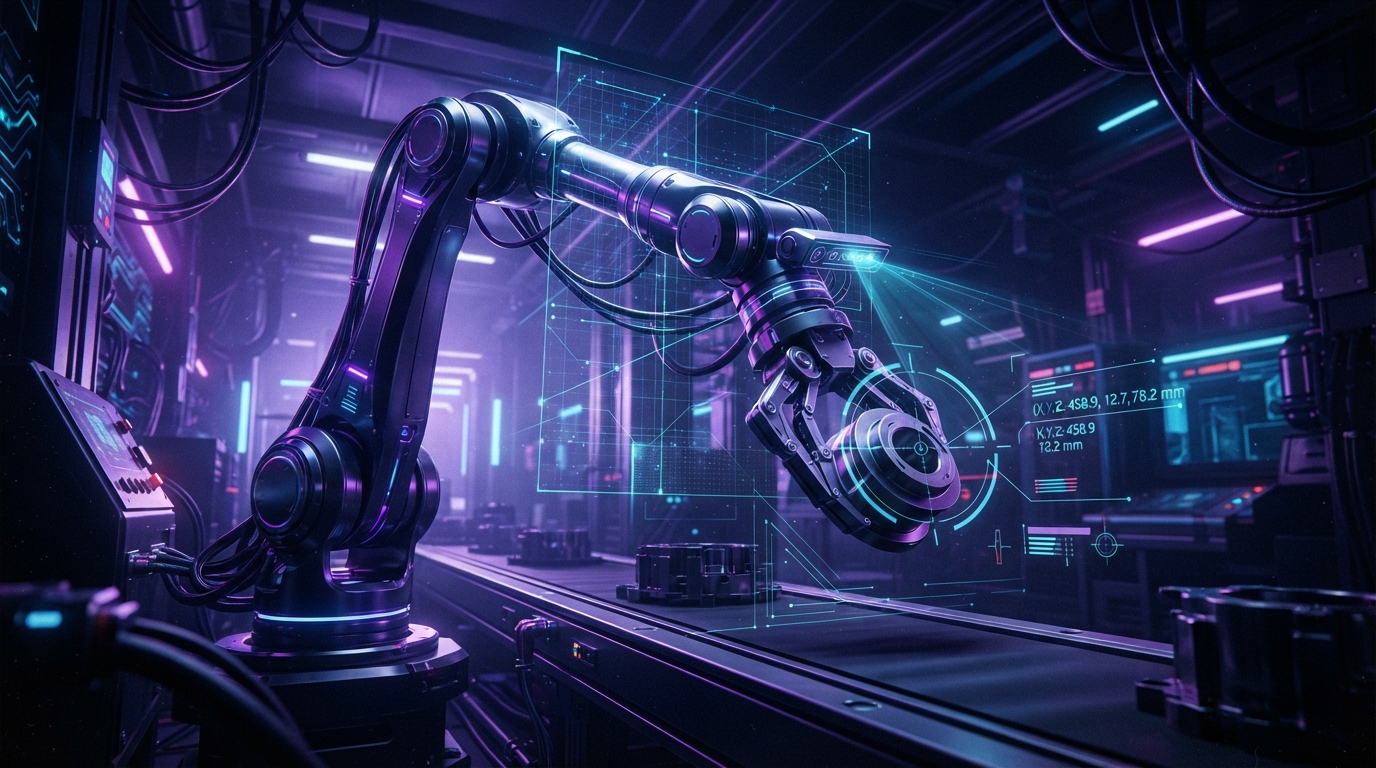
Google's robotics unit Intrinsic open-sourced the core of its own industrial robotics platform at ROSCon 2026 in Toronto, under a permissive Apache 2.0 license. Intrinsic Core hands any developer the pieces that used to be Intrinsic's paid-platform advantage: a hardware-agnostic real-time control framework, pose estimation built on Nvidia's FoundationPose, motion and grasp planning, a Gazebo-based simulator, camera calibration, and pre-configured ROS drivers for Universal Robots and FANUC arms. None of it requires an Intrinsic account, a cloud subscription, or a fee.
Intrinsic's own framing is specific about what this is and isn't: a gap-filler inside the existing ROS ecosystem, not a replacement for it. CTO Brian Gerkey -- who also co-founded and chairs the Open Source Robotics Foundation -- describes that ecosystem as strong but incomplete, particularly for the sensor-driven, mid-motion path correction that real industrial pick-and-place work actually needs, rather than the scripted, fixture-dependent motions most existing open tooling assumes. Most factory-floor robot programming today still works the way it did a decade ago: an engineer teaches an arm a fixed sequence of joint positions for one exact part in one exact spot, and the program breaks the moment a part is a few millimeters off or a supplier changes a bin's layout. The specific gap Intrinsic Core targets is that brittleness -- code that adapts to where a part actually is, sensed in real time, instead of code written for where a part is supposed to be.
“This is not us coming by and dropping off some code and saying, 'Have fun.'” — Brian Gerkey, Intrinsic CTO, on the Intrinsic Core release
Geoffrey Biggs, CTO of the Open Source Robotics Foundation, called the release 'both a first step and a demonstration of where robotics is going.' For a developer starting from a bare robot arm, the stack chains together in a specific order:
- Connects a Universal Robots or FANUC arm via Intrinsic's pre-configured ROS drivers
- Nvidia FoundationPose locates the part in 3D without a rigid fixture
- Auto-generates a collision-free path to the part
- Adapts the gripper's approach to how the part is actually sitting
- Runs the real-time, sensor-corrected execution across whichever arm is attached
- Tests the whole chain virtually before it touches a real part
The gap between free and paid is deliberate, not accidental. Intrinsic's own announcement states that anything built on Core 'automatically work[s] with other Intrinsic offerings, including our enterprise services which include advanced AI models, Intrinsic Flowstate, and industrial-grade cloud services' -- Flowstate is the no-code application-building layer Intrinsic has sold since its Alphabet 'Other Bets' days, and it stays proprietary. Core is the on-ramp, not the destination. That is, not coincidentally, close to the playbook Google ran with Android: give away the operating layer, keep the services stack, and let the free layer's adoption become the moat.
What's free now, and what still isn't
| Intrinsic Core Apache 2.0, new | Intrinsic's paid platform | |
|---|---|---|
| Real-time control, motion & grasp planning | Included | Included |
| Pose estimation, calibration, ROS drivers | Included | Included |
| No-code app building (Flowstate) | Not included | Included |
| Advanced AI models | Not included | Included |
| Industrial-grade cloud services | Not included | Included |
| Supported hardware today | Robotic arms only (UR, FANUC) | Same, plus Intrinsic's broader partner list |
The release comes seven months after Intrinsic's own status inside Alphabet changed. The company spent five and a half years developing its technology inside Alphabet's X moonshot factory before spinning out as an independent 'Other Bets' company in July 2021; in February 2026, Alphabet folded it directly into Google, with CEO Wendy Tan White now reporting to Google's chief product officer for Other Bets rather than running an independent subsidiary. An open-source release seven months into that integration reads like Google applying a familiar playbook -- give away the platform layer, keep the AI models and cloud services -- to a robotics business it now runs directly instead of at arm's length.
What Intrinsic Core doesn't yet reach matters as much as what it does. Gerkey's own comments confine this release to robotic arms in commercial deployment -- no mobile robots, no legged or wheeled platforms, no humanoids, at a moment when Figure, Unitree and a half-dozen other companies are racing to ship exactly those. Physical AI, the framing Intrinsic uses for its own mission, still means something narrower in this release than the industry-wide term has come to imply: a robot arm that can see, plan and adapt on a factory floor, not a general-purpose body doing the same in a home or a warehouse aisle. Alongside Core, Intrinsic also published a reference design called the Open Machine Tending Solution -- a working, customizable starting point for the specific job of loading and unloading parts on a CNC machine -- built on the same stack and running on the same two supported arm brands, meant to give a shop-floor integrator something to copy rather than a blank framework to fill in alone.
- Get a free, production-tested control, perception and planning stack that would otherwise cost months of in-house engineering to replicate.
- Compete against a free, Apache-licensed alternative backed by Google's own engineering and distribution.
- Its FoundationPose model is now the pose-estimation engine inside a widely distributed open-source stack, extending its reach into every project that adopts Core.
The comparison to Android is Intrinsic's own to invite, and it's also the honest risk inside it. Android's give-the-platform-away bet paid off because enough of the world's phone makers needed exactly what Google was giving away for free. Intrinsic Core is betting the same is true of robotic-arm integrators -- companies that don't want to build a control stack from scratch and would rather pay for the AI models and cloud services layered on top. Whether that bet plays out the way Android's did depends on something this release alone can't show: how many of Core's future users actually convert to the paid layer, versus how many take the free stack and never come back.
- Intrinsic, Alphabet's robotics unit, open-sourced Intrinsic Core at ROSCon 2026 under Apache 2.0.
- The release covers real-time control, pose estimation, motion and grasp planning, and ROS drivers.
- It currently supports robotic arms only -- no mobile robots or humanoids yet.
- Intrinsic's paid cloud services and AI models stay proprietary; Core is the on-ramp to them.
- Caveat: Intrinsic folded into Google directly in February, ending its run as an independent Alphabet unit.