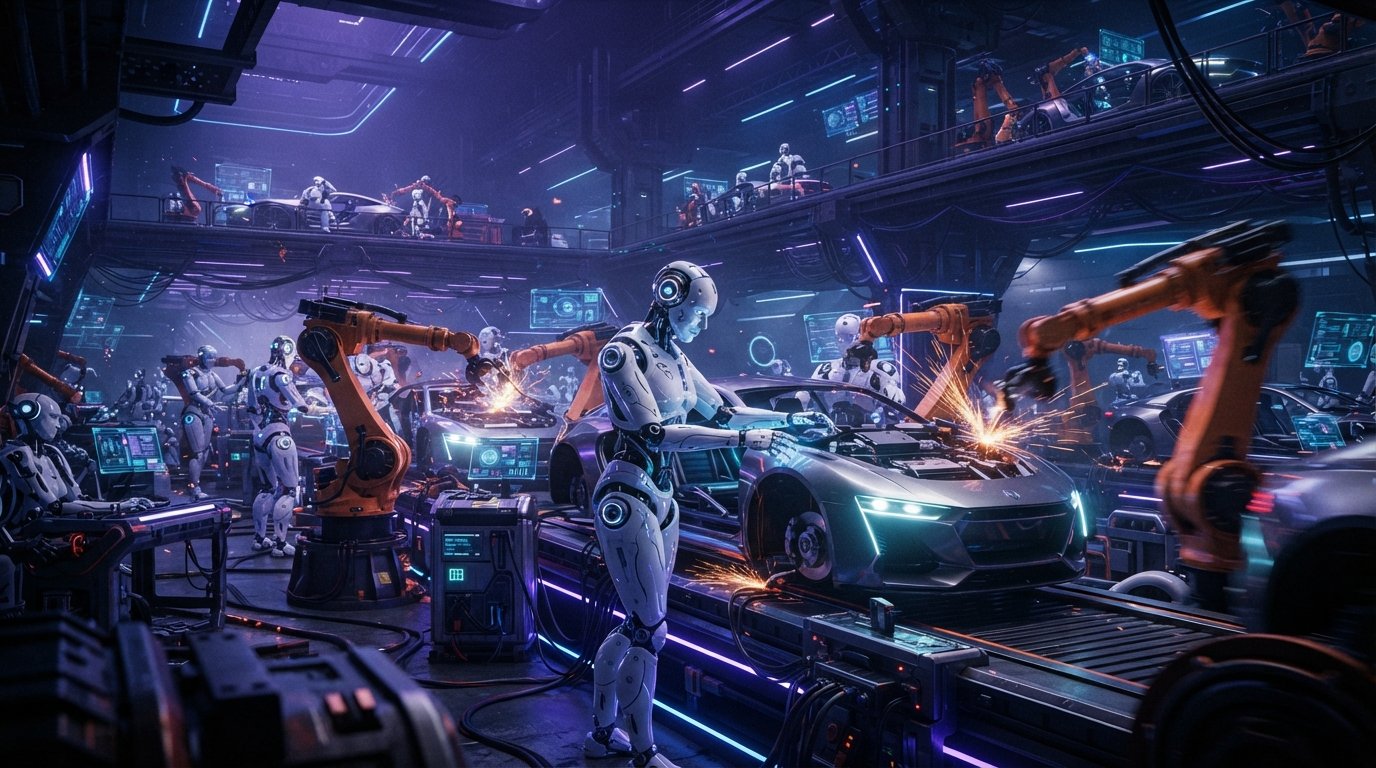
I have spent a lot of columns on this desk applying the demo-versus-shipping checklist to viral robot clips — the staged lighting, the chosen objects, the mystery take count, the ninety-second runtime that hides everything that happens at minute thirty. It's a skeptic's job, and it's the right job, because the humanoid field has run for years on highlight reels that raise rounds and prove nothing. So it is worth saying plainly, and even a little against my own reflexes, when the thing on the far side of that checklist finally arrives. Figure reports that its Figure 02 humanoids assembled over 30,000 BMW vehicles at the Spartanburg plant across an eleven-month deployment, at 99% accuracy, running roughly ten hours a day. That is not a staged kitchen with a robot catching one teacup for the camera. That is a real production line, a real duty cycle, and a real duration — the three things the highlight reels never had.
Why this clears the bar the clips never could
Walk it through the checklist and watch the objections dissolve. Chosen objects and controlled environment? An automotive assembly line is controlled, yes — but it is controlled and unforgiving, running to takt time with no patience for a robot that needs a reset every hour. Unknown take count? There are no takes on a line that produced 30,000 shipped vehicles. And the item that always mattered most, the one no clip could ever fake: endurance. A robot can be choreographed through ninety impressive seconds. It cannot be choreographed through eleven months of ten-hour days. Duration is the great honesty test of robotics, because the failure modes that hide inside a demo — heat, wear, drift, error accumulation, the thousand edge cases a real environment generates — all surface over a year. Figure ran that test in public, on a paying customer's floor.
The 99% accuracy figure is Figure's own and deserves independent confirmation before anyone enshrines it — self-reported reliability numbers always do. But notice how different the shape of this claim is from a viral video. It has a named customer (BMW), a named plant (Spartanburg), a specified duration (eleven months), and a specified duty cycle (ten hours a day). Those are the load-bearing details of a real deployment, and they are exactly the details a marketing clip omits. You can reasonably dispute the last percentage point. You cannot dispute that this is a categorically different kind of evidence than the field has ever produced before.
Endurance was the one thing a highlight reel could never fake. Eleven months on the line is the answer to it.
The field is moving, not just the one robot
This isn't a solo data point, which is what makes it read as an inflection rather than a stunt. Figure is now talking about roughly 100,000 units over four years, with a manufacturing facility — BotQ — designed for 12,000 robots in its first year. That is the language of a company planning production runs, not demo days. Tesla's Optimus V3, with its 22-degree-of-freedom hands, the AI5 chip, and Grok voice integration, is entering low-volume production at Fremont this summer — the clearest move Tesla has made from science project toward product line. And the talent is diffusing outward, which history says is the surest sign of all: Rémi Cadene, a former Tesla Optimus scientist, has unveiled UMA, a Paris-based startup building a lightweight humanoid called Northstar for factories, warehouses, and eventually homes, targeting Europe first. When the engineers who built the leading robot start leaving to found the next ones, carrying what they learned into new companies and new geographies, that is precisely the diaspora pattern that preceded expansion in automobiles, personal computers, and electric vehicles. It is starting here.
What would still update me — and what wouldn't
The honest caveat has to close this out, because the skeptic doesn't retire just because one milestone landed. An automotive assembly line is a structured, repetitive, heavily engineered environment — which is exactly where humanoids should succeed first, and which remains a very long way from a cluttered warehouse aisle, a hospital corridor, or anyone's kitchen. Structure is the humanoid's best friend, and the world is mostly unstructured. So the milestones I'm genuinely watching next are three: performance in environments that weren't purpose-engineered around the robot; an independently verified reliability figure to stand behind the self-reported 99%; and — the one that ultimately decides everything — unit economics that survive contact with a business case, meaning a cost per robot-hour that beats the human or machine alternative it replaces. Until those land, keep the excitement tempered. But don't mistake tempering for dismissal. The direction has changed. For the first time, the central question about humanoid robots is no longer 'can it actually do the work?' It is 'how many, how fast, and how cheap?' That is a later-stage, more commercial, and far more consequential question than the one this beat was asking a year ago — and earning the right to ask it is itself the news.
- Figure 02 humanoids assembled 30,000+ BMWs over eleven months, roughly ten hours a day.
- Eleven months of duty cycle is the endurance proof demo videos never offered.
- The field is scaling: Figure plans ~100,000 units; Optimus V3 enters production this summer.
- The question shifted from 'can it work?' to 'how many, how fast, how cheap?'
- Caveat: the 99% accuracy figure is Figure's own, not independently verified.