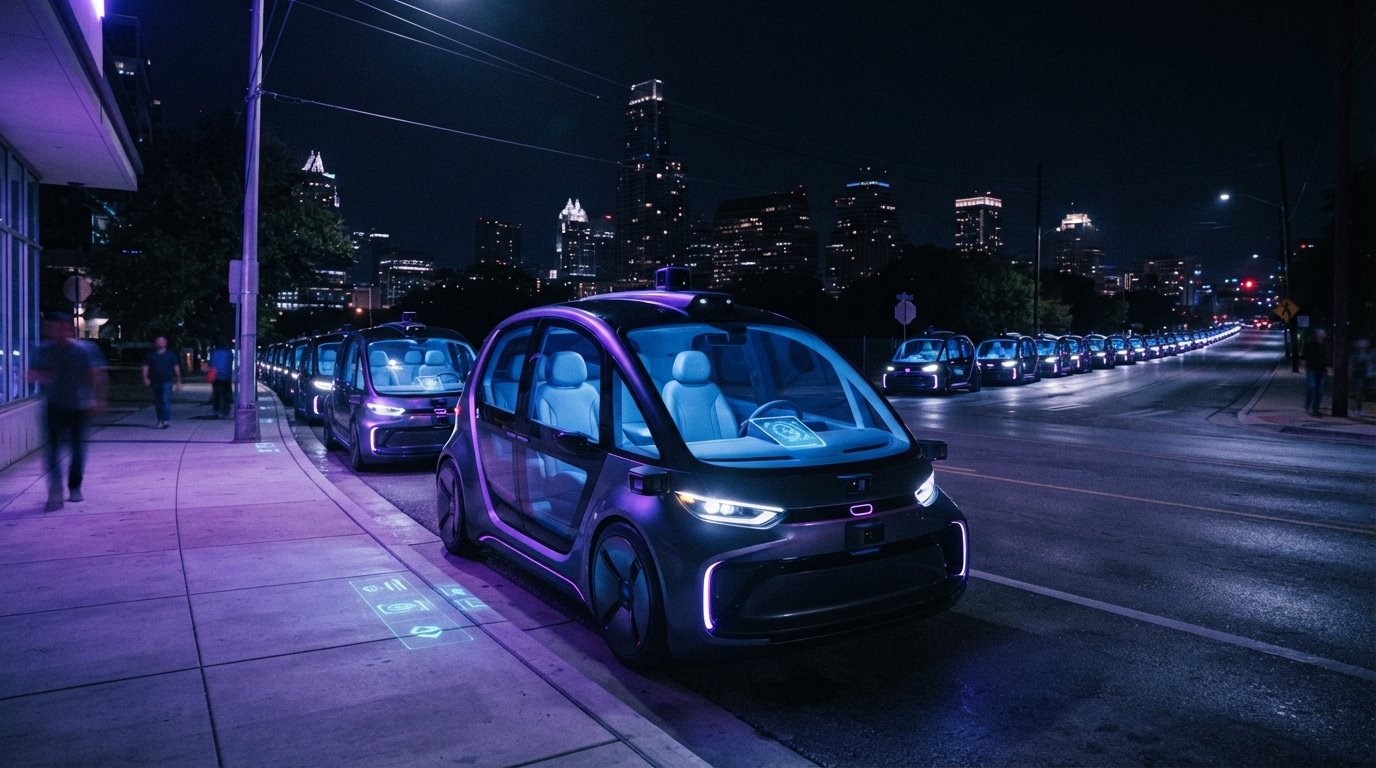
Tesla has told staff it wants Cybercab — the robotaxi it built with no steering wheel, no pedals, and no way for a human inside to take over — on Austin's public roads by the end of August, according to The Information. The rollout plan starts small: employees get rides on public roads first, and Cybercab folds into the paid Robotaxi app "a few days later," per the same reporting. Tesla's Robotaxi account is already promoting a Cybercab launch event, with rides completed through August 23 counting as contest entries — a marketing push running ahead of an official launch date Tesla hasn't yet announced.
The vehicle itself is the news here, not just the timing. Every Tesla robotaxi on the road today is a Model Y with a steering wheel and pedals still installed — a human backup option even when nobody is meant to use it. Cybercab has neither. Texas's own Department of Transportation has confirmed the production units rolling off the line at Giga Texas carry no manual controls at all, and drone footage from the factory lot backs that up — more than 100 units had already been spotted there as of July, with none yet approved to carry a paying passenger on a public road. There is no fallback if the driving system fails; there is only the driving system.
The mileage Tesla is launching on
Tesla's case for readiness rests on a number the company itself put on the record. At the July 22 earnings call, VP of AI Software Ashok Elluswamy said the fleet had logged "zero notable incidents over 380,000 miles" of unsupervised driving across six cities in two states, clarifying that the incidents that did occur involved "other actors impacting us when we were stationary" — parked, not driving. That is Tesla's own count, from Tesla's own call, and it has not been independently re-verified against raw telemetry.
“Zero notable incidents over 380,000 miles.” — Ashok Elluswamy, Tesla VP of AI Software, July 22, 2026 earnings call
Set next to the company it's chasing, that figure is small. Waymo's own public Safety Impact dashboard put its rider-only mileage at 220.6 million through the end of March — a company-reported number too, but one Waymo has published continuously and in detail since 2020, across a materially larger and longer track record. Tesla's 380,000 miles is roughly 1/580th of that total.
Tesla's unsupervised miles vs. Waymo's rider-only miles
How big is the fleet, actually
The fleet size behind that mileage is itself a moving, and inconsistently reported, target. Texas's Senate Bill 2807 let companies self-certify SAE Level 4 systems starting May 28, and Tesla Robotaxi LLC registered 42 Model Y vehicles under it that day — a fleet CNBC described at the time as less than one-tenth the size of Waymo's in the same state. By mid-July the registered count had grown further; by mid-August, Electrek's read of the same TxDMV filings put registered vehicles at 186. But registered is not the same as driving unsupervised: independent analysis of Tesla's own Q2 disclosures put the actually-unsupervised fleet — cars operating with no safety monitor at all — at roughly 17 to 21 vehicles, a number MLQ's analysis described as shrinking even as Tesla added cities.
What each Tesla robotaxi count actually measures
- 42 · Model Y, registered
- Baseline fleet registered the day SB 2807 took effect.
Includes: Vehicles Tesla self-certified as SAE Level 4 under the new law.
Excludes: Any vehicle added since May 28, or Cybercab units. - 186 · Model Y, registered
- Registered fleet as of Electrek's mid-August TxDMV filing check.
Includes: All vehicles on Tesla's Texas robotaxi registration, regardless of how they're currently operated.
Excludes: Whether a safety monitor is required in any given car. - 17–21 · Model Y, unsupervised
- Vehicles actually operating with no safety monitor, per independent analysis of Q2 disclosures.
Includes: Only cars driving with nobody in the vehicle able to intervene.
Excludes: The much larger registered count above. - 100+ · Cybercab units
- Units spotted in Giga Texas factory lots as of July.
Includes: Production units built so far.
Excludes: Any unit approved for or operating on a public road — that count is zero as of Aug. 17.
The safety record it's scaling into
NHTSA data unredacted this month shows 17 total Robotaxi incidents since the Austin service launched in mid-2025 — no major crashes, mostly low-speed contact events, several involving the Tesla being struck by someone else. Two involved a remote teleoperator taking manual control at under 10 mph: one in July 2025, when a vehicle mounted a curb and struck a fence; one in January 2026, when a vehicle collided with a construction barricade at roughly 9 mph after a teleoperator took over from a stop. Tesla says teleoperators are authorized only for low-speed repositioning, not full driving control.
- Manual controls
- Remote-teleoperator fallback
- Public-road units
- Regulatory path
None of that makes an August launch impossible — Texas's self-certification law was written to let a company make exactly this call itself, with no state inspection required before the first ride, and Tesla has already used that same law to put its current Model Y fleet on the road. It does mean the launch date is a Tesla decision resting on a Tesla-reported safety record, at a fleet size an order of magnitude smaller than the rival it's racing, in a vehicle that removes the one fallback its own incident log shows getting used. Elluswamy's 380,000-mile figure was presented on a Tesla earnings call, to Tesla's own shareholders, with no independent auditor named — worth holding separately from whether the number itself is accurate, because those are two different questions.
Robotics coverage this year has repeatedly landed on the same seam: a demo or a launch date is real, and the deployment scale behind it is much smaller than the announcement implies — the same gap this desk has tracked in humanoid-robot shipment claims and elsewhere. Cybercab is a genuine engineering milestone — a production vehicle with no manual controls, legally certified to carry paying passengers in one U.S. state. Whether it is also a safe one at scale is a question this month's launch will start generating real data on, not one 380,000 miles has already answered.
- Tesla told employees it's targeting an Austin public launch of Cybercab, its pedal- and steering-wheel-free robotaxi, by the end of August.
- The rollout starts with employee rides on public roads before Cybercab folds into the paid Robotaxi app.
- Tesla's own count is 380,000 unsupervised miles across six cities; Waymo's public safety dashboard shows 220.6 million rider-only miles through March.
- TxDMV filings and independent analysis put Tesla's actually-unsupervised Texas fleet at roughly 17-21 vehicles, well below the 186 registered under its authorization.
- NHTSA has logged 17 Robotaxi incidents since Austin's mid-2025 launch — all at low speed, none involving a vehicle with no manual controls at all.