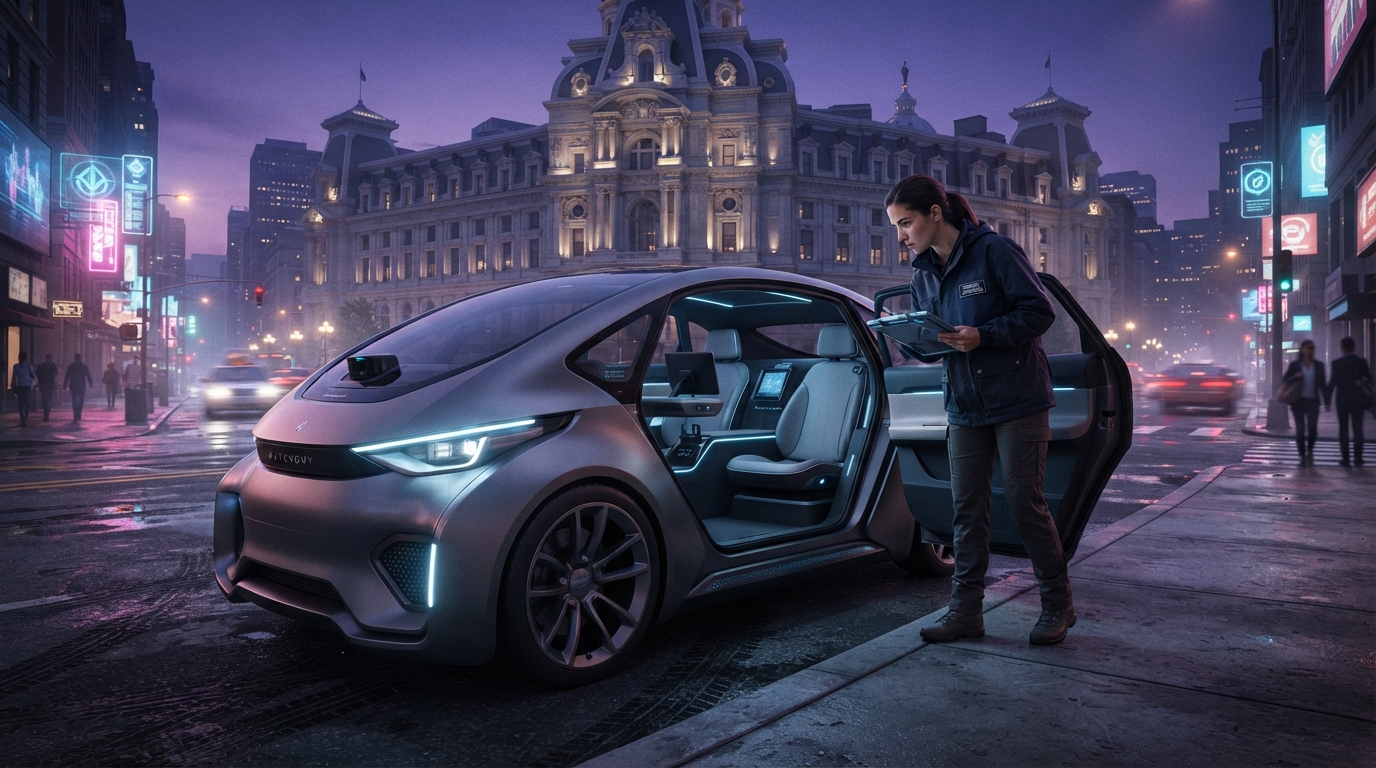
Tesla began charging riders for trips in its driverless Cybercab on the streets of Austin, Texas on September 3 -- and the same day, according to the federal government's own case file, NHTSA opened an audit into how Tesla decided the vehicle was legal to put there. The Cybercab has no steering wheel, no brake or accelerator pedal, and no mirrors -- equipment federal motor vehicle safety standards have historically required on every car sold in the US. Tesla did not ask NHTSA's permission first. It certified the vehicles itself, then started selling rides.
That move is legal under the ordinary process: US automakers certify their own compliance with federal standards, and NHTSA checks afterward rather than pre-approving a car before it reaches the road. (This is the normal system for every vehicle sold in the US, not a shortcut invented for the Cybercab -- what's unusual here is applying it to a vehicle missing controls the standards were written assuming every car would have.) NHTSA's own case file for the audit states plainly what it's checking.
Tesla is not the first company to sell rides in a car with no steering wheel. Amazon-owned Zoox got there first, and took the other route. Zoox petitioned NHTSA directly for an exemption from the same manual-control standards after self-certifying its own steering-wheel-free robotaxi in 2022; NHTSA opened a special order and then its own audit query on Zoox at the time, and the company received approval for limited commercial deployment in July 2026 -- roughly four years of federal review before its first paid ride. Tesla skipped the petition and self-certified instead, which is why regulators are now examining the reasoning after deployment rather than before it. The practical difference: Zoox's cube-shaped robotaxi carried NHTSA's own sign-off into its first commercial ride. Tesla's Cybercab is carrying a case NHTSA opened the same day, with no outcome yet attached to it either way.
Two robotaxis, no steering wheel, two different regulatory paths
| Zoox Amazon-owned | Tesla Cybercab | |
|---|---|---|
| How it sought approval | Petitioned NHTSA for an exemption | Self-certified compliance without petitioning |
| NHTSA's process | Special order, then an audit query, over ~4 years | Audit query (AQ26002), opened the day of deployment |
| Status as of Sept. 2026 | Approved for limited commercial deployment (July 2026) | Under active audit; certification basis being examined |
The scale of what's covered is still small in practice. Tesla has registered 420 autonomous vehicles in Texas, of which 45 are Cybercabs -- and it isn't clear how many of those are in paid commercial service today versus still testing. The first rides went to shareholders and invited users under NDA before Tesla said it would expand access through its Robotaxi app, the gradual rollout NHTSA's own case file references directly.
The timing complicates a clean read of who's right. NHTSA itself proposed in June to drop the manual-brake-pedal requirement for vehicles built exclusively for automated driving -- the exact standard at the center of Tesla's audit -- with NHTSA Administrator Jonathan Morrison framing the broader deregulatory push in sweeping terms. Public comment on that rule closed July 27, 2026, and adoption was expected later this year. If it finalizes, the requirement Tesla may have broken today would not exist tomorrow -- which doesn't make the audit go away, but does mean Tesla is arguably front-running a rule change already in motion, not defying a settled one it has permanently rejected.
“We are at the cusp of the greatest technological revolution in vehicle technology since the Model T.” — Jonathan Morrison, NHTSA Administrator, on the agency's broader push to loosen manual-control rules for driverless vehicles
The market's read was less philosophical. Tesla shares fell more than 4.5% within roughly an hour of the investigation becoming public that morning. 1,000 (vehicles NHTSA's audit covers -- far more than the Cybercabs actually on Austin's streets today) NHTSA's own case file puts the population under review at up to that many vehicles, a figure that reflects how far Tesla says it plans to expand the program, not how many are on the road right now.
- 2022 — Zoox self-certifies its steering-wheel-free robotaxi and petitions NHTSA for a formal exemption
- Jun 25, 2026 — NHTSA proposes dropping the manual-brake-pedal requirement for automated-only vehicles (FMVSS 135)
- Jul 27, 2026 — Public comment period on that proposal closes
- Jul 2026 — Zoox receives NHTSA approval for limited commercial deployment
- Sep 3, 2026 — Tesla begins commercial Cybercab rides in Austin; NHTSA opens Audit Query AQ26002 the same day
- Later 2026 — FMVSS 135 rule change expected to be finalized
None of this means Tesla broke the law, and NHTSA isn't claiming that yet either -- an audit query is a request for the paperwork and the reasoning behind it, not a finding, a recall order, or a fine. Automakers have talked their way out of audit queries before by supplying the technical file NHTSA asked for. But it is the second major open NHTSA inquiry into Tesla's driving systems at once: a separate, long-running probe into Full Self-Driving already covers 3.2 million vehicles over visibility-related crashes. What AQ26002 adds is a company betting a brand-new product line on a legal interpretation regulators are actively deciding whether to bless -- during the exact months the rule that would settle the question either way is sitting, unfinalized, on NHTSA's own desk. Whether Tesla's bet pays off now rests on paperwork the public hasn't seen and a rulemaking clock nobody has committed to a date for.
- NHTSA opened Audit Query AQ26002 the same day Tesla began commercial Cybercab rides in Austin.
- The probe covers up to 1,000 vehicles that lack a steering wheel, pedals, and mirrors.
- Zoox petitioned NHTSA for the same missing controls and won approval in July; Tesla self-certified instead.
- Tesla shares fell more than 4.5% within about an hour of the investigation becoming public.
- Caveat: NHTSA is auditing Tesla's certification process, not alleging a defect or ordering a recall.