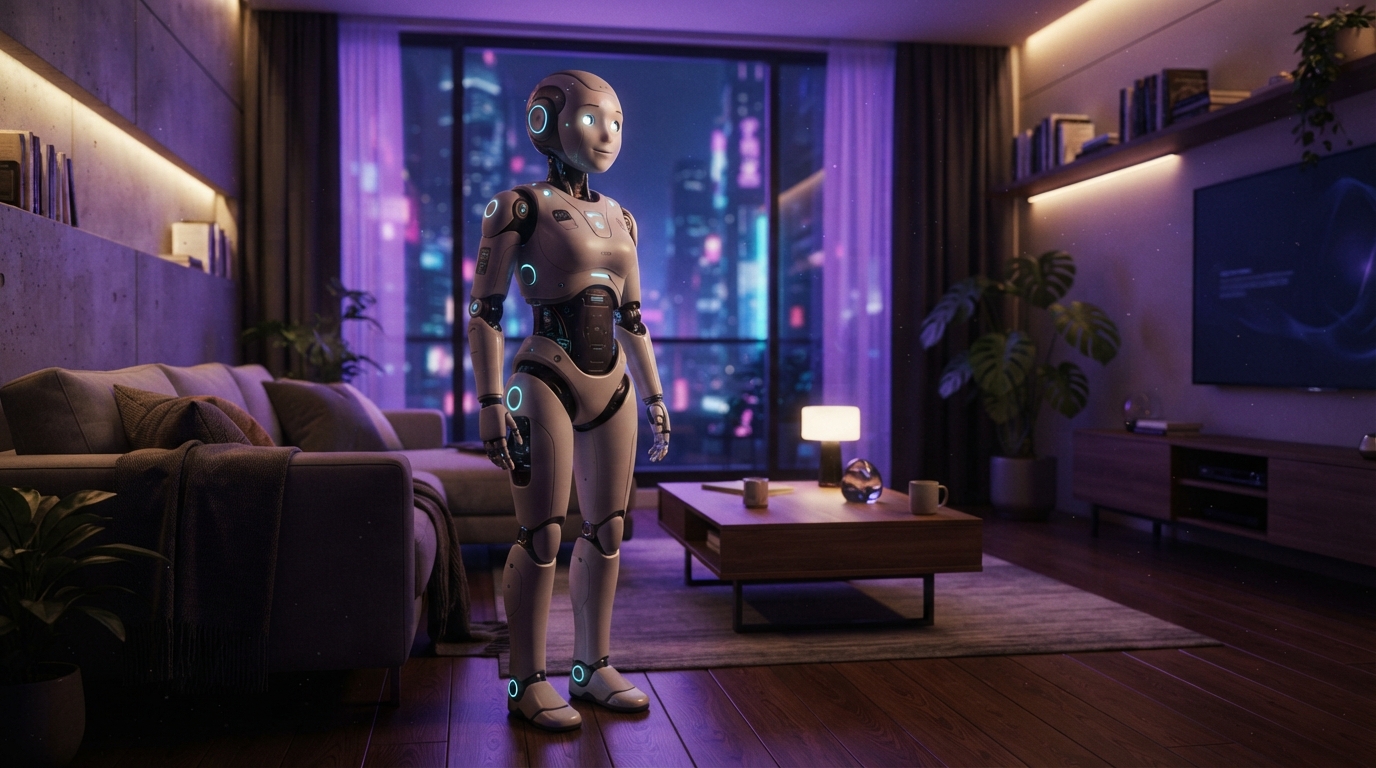
UBTech's new consumer brand UWORLD begins delivering its U1 humanoid companion robot this week -- no later than September 15, per the company -- to the more than 13,000 people in mainland China who have pre-ordered one since its June launch. Priced from 119,800 to 990,000 yuan (roughly $16,500 to $136,000) across three tiers, the U1 is pitched not as a labor-saving machine but as an "emotional companion": UBTech says it reads a user's tone, facial expression and speaking pace, and stores what it learns in local encrypted memory to personalize itself over time.
None of that emotional-AI pitch is independently verified. UBTech has disclosed no model architecture, no benchmark and no third-party evaluation of the mood-detection claim -- as of this reporting, it exists only in the company's own marketing copy and retailer listings.
On raw hardware, the two robots are close enough to invite the comparison directly. UBTech's U1 comes in a 183cm/42kg male-styled build and a 168cm/35.2kg female-styled build, each with 88 degrees of freedom; 1X's Neo is smaller at 168cm and 30kg but tendon-driven, rated for a 70kg payload despite the lighter frame. Neo sells for $20,000 outright or $499 a month, against the U1's 119,800-to-990,000-yuan range paid up front -- more than 10,000 Neo units and more than 13,000 U1 units were pre-ordered before either company had shipped a single one to a paying household.
The physical limits are more mundane than the marketing. Both U1 SKUs run 2 to 4 hours per charge and are built for flat indoor surfaces -- UBTech's own materials describe standing, sitting and walking, not stairs or rough terrain. A companion robot that needs recharging roughly as often as a phone, and can't leave the room it's demoed in, is a real product; it's a different one than the always-present, go-anywhere household presence the "emotional companionship" framing implies.
UWORLD is a new consumer sub-brand, not UBTech's first humanoid line -- the parent company also builds industrial and service robots, and competes domestically with Unitree, whose own Shanghai listing popped 629% before giving back half that gain within weeks. The U1 is UBTech's bet that a mass-produced, price-tiered companion robot -- sold on emotional connection rather than labor substitution -- is a market Unitree's industrial and athletic humanoids don't reach.
A companion robot built around reading a user's tone and expression also means a robot with an always-available camera and microphone inside the home, personalizing itself off what it observes. UBTech's marketing describes the memory as "local" and "encrypted," but doesn't specify what leaves the device, if anything, for model updates or support -- a question that applies just as directly to Neo, whose entire teleoperation model requires a live camera and audio feed reaching a remote operator by design. 1X at least discloses that design choice and gives owners some controls over it; UWORLD's privacy architecture, beyond the words "local" and "encrypted," is undocumented in what's public so far.
The roughly $120,000 gap between the cheapest and priciest U1 does track a disclosed hardware difference -- Lite is a semi-torso edition, Pro and Ultra are full-body with progressively higher-performance actuation -- but UBTech has not published any tier-by-tier breakdown of the emotional-AI capability itself. Every price point is sold on the identical, undisclosed mood-detection pitch; only the body underneath it is specified, which means the emotional-AI premium itself is priced the same whether a buyer spends $16,500 or $136,000.
UWORLD U1 against the closest thing the US has to a rival
| UWORLD U1 (UBTech) | NEO (1X) | |
|---|---|---|
| Price | 119,800-990,000 yuan (~$16,500-$136,000), one-time | $20,000 outright, or a $499/month subscription |
| Market | Mainland China only | United States, staggered rollout |
| Build | 183cm/42kg (male) or 168cm/35.2kg (female), 88 degrees of freedom | 168cm, 30kg, tendon-driven with a 70kg payload capacity |
| Delivery status | First deliveries promised by Sept. 15, 2026 | No verified customer delivery as of mid-2026; shipments promised "before the end of 2026" |
| How the marketed "understanding" actually works | Undisclosed -- described as an "emotional AI model," no architecture published | Confirmed by outside reporters: home demos were run by a remote human operator in a VR headset |
The comparison matters because Neo is the one real data point the industry has for what happens when a marketed "autonomous companion" robot gets outside scrutiny. 1X's own home demonstrations -- fetching items, loading dishes, tidying up -- were, according to multiple outside reporters who watched them, run in real time by a person wearing a headset at 1X's office, not by the robot's own software. 1X doesn't dispute this; its CEO, Bernt Børnich, has framed it as the honest version of a common industry practice: "We hope to ship a mostly fully autonomous robot in 2026, but chose to not promise anything that does not already work today. Hopefully breaking with the trend."
“We hope to ship a mostly fully autonomous robot in 2026, but chose to not promise anything that does not already work today. Hopefully breaking with the trend.” — Bernt Børnich, CEO, 1X Technologies
- UWORLD U1 has logged more than 13,000 pre-orders since its June launch.
- The U1's AI can detect a user's mood from tone, expression and speaking pace.
- NEO can perform home chores autonomously.
None of that makes either company's product worthless -- a $20,000 robot that a human quietly helps operate, or a $16,500 companion whose mood-reading is unproven, can still be real products people want. It does mean the actual, tested gap between the marketing and the machine is unusually wide for a category this expensive, and the people carrying that gap are the ones who already paid.
- Paying up to $136,000 for emotional-companionship claims no outside party has tested.
- Already told teleoperation is part of the deal, still waiting on 1X's own promised year-end shipping window.
- First mover into mass-produced, price-tiered consumer humanoids -- a category no US company has actually shipped into yet.
The pivot itself is worth naming. Most of the humanoid-robot funding and coverage of the past two years -- Unitree's industrial and athletic machines, Figure's warehouse deals, Tesla's Optimus -- has been pitched on labor substitution: a robot that does a job a person used to do. UWORLD and Neo are both explicitly pitched on the opposite framing, companionship rather than labor, which is a harder claim to falsify with a benchmark and an easier one to sell on a demo alone. That's not evidence either company is being dishonest -- it's a reason outside scrutiny matters more for this category than for one where a robot either picks up the box or it doesn't.
Both companies are selling the same underlying promise: a humanoid that understands and helps you, not just one that looks impressive in a demo video. Neo's launch already answered what "understands" turns out to mean in practice for at least one of them. UWORLD's answer arrives with its first delivered units, sometime after September 15 -- and whether anyone outside UBTech gets to actually test the claim is the open question worth tracking, not the pre-order count.
- UBTech's UWORLD U1 companion robot begins deliveries this week, mainland China only.
- Pricing spans 119,800 to 990,000 yuan (about $16,500 to $136,000) across three tiers.
- UBTech's "emotional AI" mood-detection claims are undisclosed and untested outside the company.
- 1X's rival Neo made the same "autonomous companion" pitch; reporters found live demos run by remote humans.
- Caveat: 13,000+ pre-orders is UBTech's own reported figure, not independently confirmed.