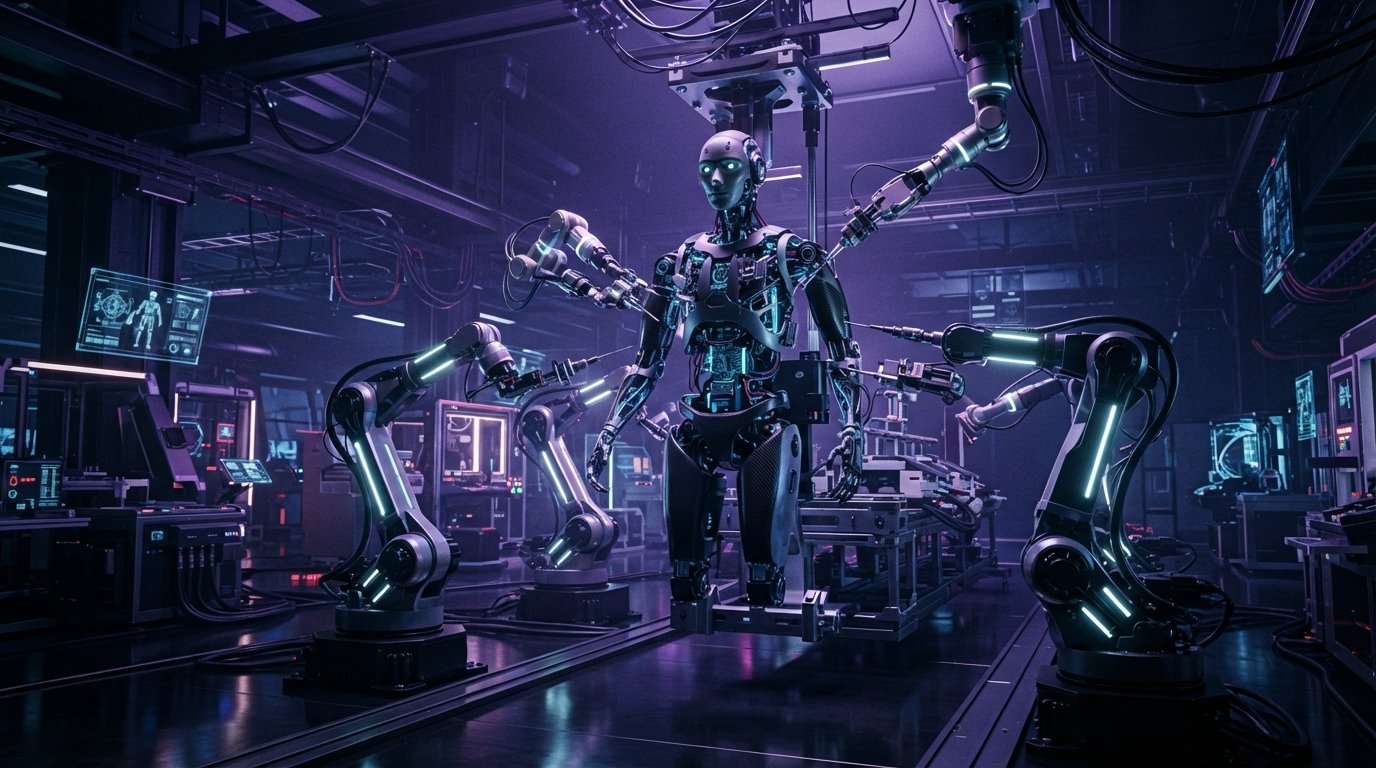
On September 8 in Guangzhou, XPeng's IRON humanoid robot walked off a dedicated manufacturing line under its own power -- what the company calls the world's first automated production line built specifically for advanced humanoid robots. Core assembly processes are more than 80% automated, built to the same automotive-grade quality systems XPeng already runs for its electric vehicles. "Today's step is small, but XPeng is building the production lines for an entirely new product category," chairman and CEO He Xiaopeng said, adding that the goal is a robot with full generalization capabilities -- not a single-task machine.
IRON has 76 degrees of freedom across its body -- 21 in each hand alone -- and runs on three of XPeng's own in-house Turing AI chips delivering up to 2,250 TOPS of onboard compute, enough for it to operate without remote teleoperation. Its outer shell uses a flexible lattice structure that doubles as a safety feature, part of what XPeng is pitching as an automotive-grade quality system applied to a category that has mostly been built by hand in small batches so far. The same chips run XPeng's own vision-language-action foundation model directly onboard -- the software stack the company says lets IRON interpret a task and act on it without a remote operator or a pre-scripted routine.
IRON itself isn't new. XPeng first unveiled this robot generation at its AI Day on November 5, 2025, where its fluid, human-like walk drew widespread online speculation that a person was hidden inside the suit -- doubt the company spent the following days publicly rebutting. Ten months later, the September 8 milestone belongs to the same robot line's manufacturing story, not a new reveal: the question has moved from *is it real* to *can it be built at scale*.
IRON, in short
- Degrees of freedom
- 76 total, 21 per hand
- Onboard compute
- 3 in-house Turing AI chips, 2,250 TOPS
- Line automation
- 80%+ of core processes
- Mass production target
- End of 2026 (internal use first)
- Commercial launch
- 2027, China and overseas
A line, not yet a factory
Three separate milestones are getting compressed into one announcement, and they are not the same claim. A robot walking off an assembly line means the line can build one; XPeng's own timeline puts actual mass production at the end of 2026, with initial units going to the company's own stores and industrial campuses first. A commercial launch, with deliveries to outside customers in China and overseas, isn't scheduled until 2027. The gap between those three dates is exactly the gap the humanoid-robot industry has struggled to close all year -- and it's the same gap Tesla is still working through with Optimus, after Elon Musk predicted roughly 10,000 Optimus units for 2026 and then admitted in January that none were yet doing useful work. For a business that just priced a $6.3 billion valuation on the strength of this same event, that distinction isn't academic: it's the difference between what investors just paid for and what they're still waiting to see.
Two automakers, two humanoid-robot lines
| XPeng IRON | Tesla Optimus | |
|---|---|---|
| Dedicated robot assembly line | Activated Sept 8, 2026 -- purpose-built | Still being converted from a car production line |
| 2026 production status | Targeting mass production by year-end, internal use first | Musk predicted ~10,000 units in 2026; said in January none were doing useful work yet |
| Commercial delivery | 2027, China and overseas | Not yet publicly scheduled |
| Onboard compute, disclosed | 3 in-house Turing chips, 2,250 TOPS | Not disclosed at this level of detail |
The line is backed by real money. XPeng's robotics business raised over $900 million on August 24 at a $6.3 billion post-money valuation -- the largest single private financing round in China's embodied-AI industry to date. IDG Capital led, with Gaorong Ventures participating and Tencent and Alibaba joining as strategic investors; XPeng itself contributed $200 million of the total and senior executives put in another $100 million alongside $600 million from outside investors. The company says the money goes to software and hardware R&D, Physical AI model training, data generation, mass-production facility development, and global commercial expansion.
Accelerate the growth of our robotics business, while strengthening our ability to attract more world-class Physical AI talent.
None of that guarantees the gap between a line that works once and a factory that ships on schedule actually closes.
XPeng is not the only Chinese automaker racing to prove this at scale. AgiBot shipped roughly 8,400 humanoid units and Unitree about 5,900 in the first half of 2026 alone, out of a global total of roughly 19,100 -- with Chinese manufacturers responsible for 97% of it, and BYD entered the same race in August with its own showroom-greeter prototype. Car companies bring manufacturing scale that purpose-built robotics startups like AgiBot don't have, which is precisely XPeng's bet: that automotive-grade production discipline, not robotics pedigree, is what actually closes the demo-to-shipment gap. XPeng's line is the most automated production claim any of them has made public so far. Whether that translates into a robot a customer can actually buy is a 2027 question, not a September one.
- XPeng's IRON humanoid robot walked off a dedicated, automated production line on September 8.
- The line runs on automotive-grade quality systems, with core processes over 80% automated.
- It follows a $900 million raise on Aug. 24 that valued XPeng's robotics unit at $6.3 billion.
- Mass production is targeted for end of 2026; outside commercial deliveries aren't slated until 2027.
- Caveat: one unit walked off a line once. A disclosed production rate and a paying customer are still ahead.